
Skills range from 0% to 100%. Test one only when the outcome is uncertain and failure would matter.
Shaping is a Knowledge skill granted by the Shaping Talent, not a general skill.
Chapter 02
Resolve uncertain actions with capped D100 skills, Bonus and Penalty dice, opposed tests, assistance, and a compact skill list.
Skills range from 0% to 100%. Test one only when the outcome is uncertain and failure would matter.
Shaping is a Knowledge skill granted by the Shaping Talent, not a general skill.
Roll D100 against the relevant skill, as described in Make a test. 00 reads as 100.
Do not roll for routine work when the character has enough time, suitable tools, and relevant competence. Roll when pressure, danger, limited time, or real uncertainty makes both success and failure interesting.
Check fumbles first; a fumble overrides success. The result grades are Critical, Success, Failure, and Fumble. Skills cannot exceed 100%. At 100%, rolls 01–10 are Critical, 11–99 Success, and 00 a Fumble.
Use the integer tens digit, not rounding. Any skill above 0% has a critical range of at least 01.
| Skill | Critical range |
|---|---|
| 0% | none |
| 1–19% | 01 |
| 20% | 01–02 |
| 59% | 01–05 |
| 60% | 01–06 |
| 99% | 01–09 |
| 100% | 01–10 |
Deadly Precision is the one exception: it doubles the normal range for one eligible weapon attack. Other tests keep their normal range.
A Critical achieves the stated intent especially quickly, thoroughly, or effectively, and may reveal an extra benefit or useful information.
A Fumble fails and adds a serious consequence that fits the declared action, such as lost time, damaged equipment, danger, or a worse position. It should follow from the risk already present, not invent an unrelated disaster.
Bonus dice (+1B, +2B…) improve a test; Penalty dice (-1P, -2P…) hinder it.
+3B or -3P.D100 results. Read 00 as 100.Which result is better? Grade every candidate first: Critical > Success > Failure > Fumble. Within Critical or Success, the higher roll is better. Within Failure or Fumble, the lower roll is better. Use this order even when the test is not opposed. If Deadly Precision applies, grade every candidate with its doubled critical range.
Choose the result before comparing participants in an opposed test. Base skill and defender or status-quo tiebreakers never choose between one roller’s candidates. Bonus and Penalty dice change the roll, not the skill or its critical range.
Apply dice only for circumstances that materially change the task, such as terrain, tools, visibility, preparation, time pressure, injuries, or a sound or flawed approach.
A modest advantage or obstacle is usually +1B or -1P. Use larger modifiers only when several strong factors point the same way; the final net modifier never exceeds three dice.
Use an opposed test when two characters directly compete, or one actively resists another. Each participant rolls the relevant skill with their own Bonus or Penalty dice. Resolve each participant’s Bonus or Penalty dice before comparing their final results.
These tiebreakers compare participants only; they never choose between one participant’s Bonus or Penalty candidates.
Weapon defences add one combat exception: an ordinary successful Dodge or Parry still demotes a critical attack to an ordinary hit, without blocking damage. Grappling and Shaping do not use that exception.
Example. Two ordinary Successes of 42 and 31 favour 42. Two Failures of 72 and 85 favour 72. A Critical always defeats an ordinary Success, whatever the numbers.
One or more characters can assist when they have a practical way to contribute. The Gamemaster decides whether the method and the time available make assistance possible.
+1B to the acting character’s test in total, not per helper. Exceptionally effective combined help can grant +2B.| Skill | Base | Use |
|---|---|---|
| Dodge | DEX + 10 |
Evade attacks and avoid physical hazards. |
| Persistence | POW + 10 |
Resist coercion, fear, and attacks on resolve. |
| Resilience | CON + POW |
Endure fatigue, deprivation, poison, disease, and bodily shock. |
| Close Combat | DEX + STR |
Attack and Parry with hand-to-hand weapons and shields. |
| Ranged Combat | DEX + INT |
Attack with bows, crossbows, slings, and thrown weapons. |
| Unarmed Combat | DEX + STR |
Fight with fists, kicks, grapples, and natural weapons. |
Use Dodge against an attack or physical danger you can perceive and move away from. The Combat rules say when it needs a Reaction or Penalty dice.
Persistence is mental resolve. Use it to resist Influence, intimidation, fear, and other attempts to override your judgement or will.
Resilience is physical endurance. It is the standard skill for Fatigue tests and for resisting poison, disease, exposure, starvation, thirst, and similar bodily threats.
Close Combat covers melee weapons and shields. Ranged Combat covers missile and thrown weapons. Unarmed Combat covers grappling and natural attacks: an unarmed human normally deals 1D3 damage and counts as Light, while a natural weapon uses its listed damage and Size, defaulting to Medium.
The Combat chapter defines attacks, Parries, Dodges, damage, range, and weapon restrictions.
| Skill | Base |
|---|---|
| Culture (own) | INT + 10 |
| Culture (other) | INT |
| Language (own) | INT + 50 |
| Language (other) | INT |
| Lore (own field) | INT + 10 |
| Lore (other) | INT |
| Natural Lore | INT + 10 |
Each foreign Culture, foreign Language, and Lore field is a separate skill. Choose one own field of study at character creation.
Culture recalls a society’s history, politics, geography, customs, superstitions, and common beliefs. Use Culture (own) for your home society and Culture (other) for each foreign society you study.
Each Language is separate. At 50% or more you speak fluently; lower scores allow simpler communication, in proportion to the skill.
Each Lore is a specialised field of study that improves separately. Common fields are Alchemy (reagents, distillation, poisons, and antidotes), Magic, Military Tactics, Spirit World, Undead, Law and Heraldry, and Astronomy. Other fields, such as art, gambling, or philosophy, work the same way.
A successful Lore test also grants +1B to one directly related skill test made soon after, when recognition or preparation would plausibly help.
Natural Lore covers the living world, terrain, and survival.
| Skill | Base |
|---|---|
| Athletics | DEX + STR |
| Craft (type) | INT + 10 |
| Deception | DEX + INT |
| Driving | DEX + INT |
| Healing | INT + 10 |
| Influence | CHA + 10 |
| Mechanisms | DEX + INT |
| Perception | INT + POW |
| Performance | CHA + 10 |
| Riding | DEX + POW |
| Sailing | DEX + INT |
| Streetwise | CHA + POW |
| Trade | INT + 10 |
Each Craft subject is a separate skill.
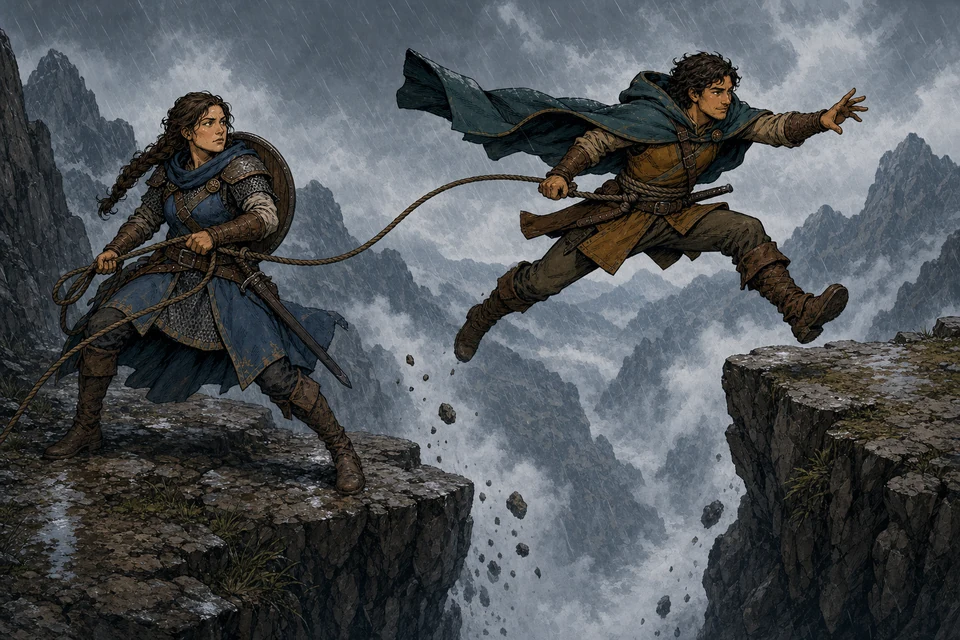
Athletics covers acrobatics, force, climbing, jumping, running, and swimming.
-1P, subject to the normal -3P cap.Choose a trade such as blacksmith, bowyer, brewer, carpenter, mason, potter, or tailor. Craft makes and repairs suitable goods. As a rough guide, work takes one day per 50 SP of finished value and uses materials worth half that value.
Deception covers disguise, hiding objects, picking pockets, stealth, and misdirection. Attempts to avoid notice are usually opposed by Perception. To pickpocket or plant a small item normally needs at least one minute of sustained access.
Driving covers carts, chariots, wagons, and similar vehicles. No test is needed at walking pace on flat ground; test for speed, dangerous terrain, jumps, collisions, or difficult manoeuvres.
Healing needs a Healing Kit; without one, the test is at -2P.
1D4 HP.+1B to the patient’s next Resilience test against the affliction.Healing and Recovery gives the full wound and recovery procedure.
Influence persuades, bargains, commands, or intimidates through words and conduct. When the target resists, oppose a suitable skill, usually Persistence or Influence. Success can change the target’s immediate decision, but cannot force action against basic self-preservation.
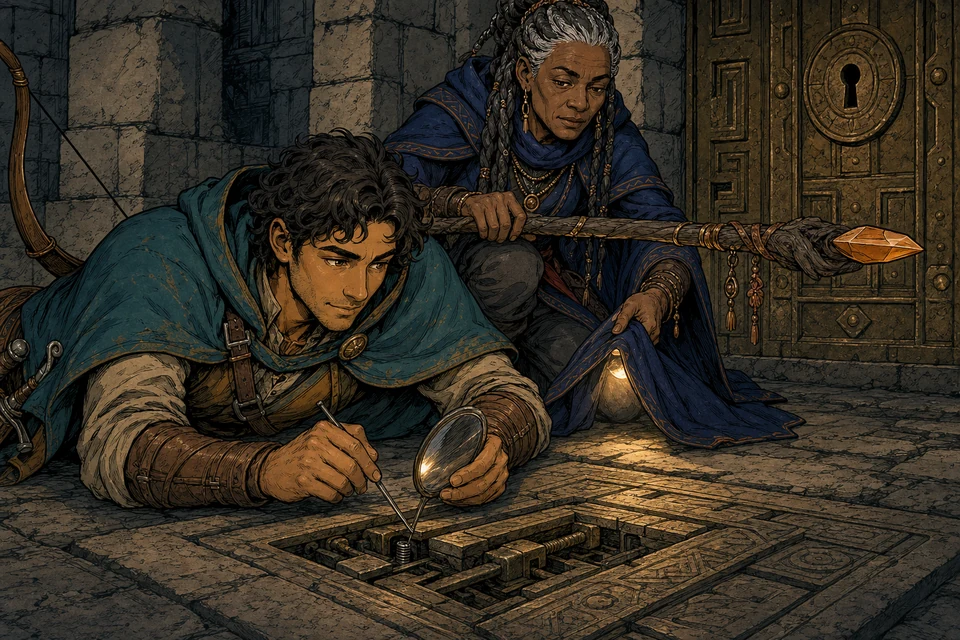
Mechanisms designs, assembles, repairs, operates, and disables mechanical devices and engineered structures. All its uses share one skill score; Engineering is not a separate skill.
Use Mechanisms to assess, design, construct, repair, or sabotage large works such as bridges, fortifications, mines, siege engines, gates, and ships. Projects require suitable tools, materials, labour, and time. Engineering does not replace Craft for making goods and components, or Sailing for navigating and manoeuvring vessels.
Perception uses the senses to notice concealed creatures, hidden objects, small details, and approaching danger. It commonly opposes Deception.
Performance covers acting, dance, music, oratory, poetry, and song. A success gives a competent, pleasing performance that suits your intent.
No test is needed to ride a trained mount at walking pace on flat ground with saddle and tack. Test for dangerous terrain, speed, jumps, bareback riding, frightened mounts, or combat manoeuvres.
Sailing operates boats and ships under oar or sail. Calm routine travel needs no test; currents, storms, racing, navigation hazards, and damaged vessels do.
Streetwise finds rumours, illicit goods, fences, black markets, safe routes, and people who prefer not to advertise. Gathering information or finding a contact normally takes 1D4 hours. Streetwise also covers discreetly following someone through a busy settlement.
Use an opposed Trade test to negotiate a price. The winner moves the price 10% in their favour, or 20% on a Critical. Double the change when the opponent Fumbles.
Trade also appraises market value. A success estimates an item’s ordinary local value to within 10%; unusual scarcity or obscurity can add Bonus or Penalty dice.