Use these rules when the environment matters enough to create danger or a real cost. Do not roll for routine travel or harmless conditions.
Chapter 07
Adventuring
Practical procedures for travel, darkness, fatigue, survival, healing, hazards, and damaged objects.
Daily pace
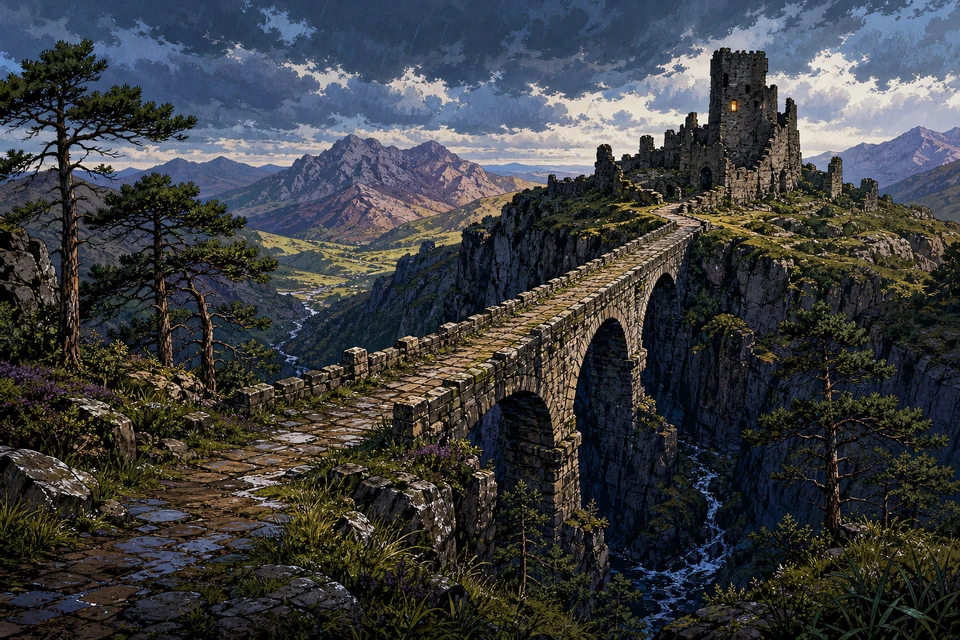
Daily rates assume ten hours of travel in fair conditions. When it matters who arrives first, make an opposed Athletics test for groups on foot, or Riding for mounted groups.
| Pace | Distance per day | Cost |
|---|---|---|
| Hiking | 50 km | Steady walking on a road or path, without wagons or animals; make a Fatigue test at day’s end. |
| Marching | 30 km | An organised pace that leaves the group ready to fight; no end-of-day Fatigue test. |
| Riding slowly | 30 km | Walking mounts, pack animals, or wagons. |
| Riding | 50 km | Casual riding. |
| Riding fast | 90 km | No wagons; both rider and mount make a Fatigue test at day’s end. |
Multiply the chosen rate by the worst terrain crossed for a substantial part of the day.
| Terrain | Rate |
|---|---|
| Road or path | 100% |
| Light brush | 80% |
| Medium brush | 70% |
| Light woods | 70% |
| Rolling hills | 70% |
| Heavy woodland | 50% |
Navigation
Once per uncertain travel day, make a Natural Lore navigation test, and test again after a material route change.
- On a Success, make full progress.
- On a Failure, lose one quarter of that day’s progress.
- On a Fumble, make no progress and become lost.
Weather, steep slopes, navigation errors, forced stops, and exceptional mounts can change the final distance at the Gamemaster’s discretion.
For vision and attacks, use the illumination reaching the observed target; for Movement, use the light reaching the mover. A light source illuminates its listed radius, and weaker bands extend beyond it.
Mist, fog, foliage, and smoke are obscurity, not illumination. Apply their ranged-combat modifier along the sightline separately. Shaped light or obscurity pays for its mechanical outcome; any mundane light it creates then uses these bands.
| Source | Radius |
|---|---|
| Candle or embers | 1 m |
| Torch or lantern | 3 m |
| Campfire | 5 m |
| Bonfire | 10 m |
| Illumination | Examples | Effects |
|---|---|---|
| Bright | Clear daylight | None. |
| Illuminated | Overcast daylight; inside a light’s radius | None. |
| Partial darkness | Twilight; outside the radius but within ×3 | -1P to vision-based Perception and attacks. |
| Darkness | Starlight; beyond ×3 but within ×5 | -2P to vision-based Perception and attacks; half Movement. |
| Pitch black | Sealed cavern; beyond ×5 with no other light | Vision-based Perception and ranged attacks cannot succeed without another applicable sense; Close attacks suffer -3P; quarter Movement. |
Other senses
- Night Vision: natural surface night counts as Illuminated. It does not help underground, in sealed or supernatural darkness, or against obscurity.
- Low-Light Sight: treat Partial darkness as Illuminated and Darkness as Partial darkness. Pitch black is unchanged.
- Blind Sight (sense): ignore illumination for a target the named sense accurately perceives. It gives no colour, writing, fine visual detail, or eye contact. State what blocks it, such as a wall blocking heat or loud noise masking hearing. Use only the best applicable sense; senses do not stack.
After strenuous activity, such as a long fight, sprint, hard climb, or strong-current swim, the Gamemaster can call for a Fatigue test: a Resilience test. Test after the activity, unless exhaustion could stop you finishing it.
| State | Skill tests | Movement | Combat Order |
|---|---|---|---|
| Fatigued | -1P |
Three-quarters | -3 |
| Exhausted | -2P |
Half | -6 |
- A failed Fatigue test makes a fresh character Fatigued.
- Strenuous activity while Fatigued calls for another Fatigue test at
-1P; failure makes the character Exhausted. - A fumbled Fatigue test causes unconsciousness for
3D6minutes. The character wakes Fatigued. 20 − CONhours of complete rest, minimum 1, removes Fatigued or Exhausted.
Reduced Movement is never less than 1 metre.
Exposure, starvation, and thirst
| Deprivation | Grace period |
|---|---|
| Exposure without adequate shelter | CON hours |
| Starvation | CON days |
| Thirst | CON × 2 hours; CON hours in arid conditions; CON ÷ 2 hours in extreme heat |
After three days without food, Fatigue tests are at -1P, even if the starvation grace period has not ended.
Once a grace period ends, make one Fatigue test at -1P for that deprivation each day, and take 1D6 damage per day for each active deprivation. This damage cannot recover naturally until shelter, food, or water fixes its cause.
This section covers healing after the fight. Damage and Wounds covers Major Wounds, Bleeding, Dying, and stabilising a dying character. Healing needs a Healing Kit; without one, the test is at -2P.
Treating ordinary damage
After an encounter, a character who is not Wounded can receive one Healing attempt before their next full rest. Success restores 1D4 HP. The limit is one attempt per patient, not one success.
Surgery and natural recovery
A Wounded character cannot recover HP naturally until successful Surgery or equivalent treatment. Surgery uses Healing, cannot be attempted during combat, needs safe working conditions, and restores 1 HP on a success.
With no more than light activity, a character recovers a quarter of CON in HP per 24 hours, up to maximum HP. A Wounded character starts this recovery only after treatment. Wounded ends once current HP is greater than Major Wound Level.
Alter·Flesh healing at Intensity 3+ counts as equivalent treatment.
Carrying capacity
Encumbrance (ENC) measures weight and awkwardness together. Armour, weapons, containers, and their contents all count toward the carried total. Items marked — are negligible alone; in a suitable container, every 20 of them count as 1 ENC.
Capacity. You carry up to STR + SIZ ENC without penalty.
Overloaded. Above Capacity, you:
- suffer
-1Pon physical tests, including weapon tests and most tests based on STR or DEX; - have half Movement; and
- suffer
-1Pon Fatigue tests.
You cannot carry more than 2 × (STR + SIZ) ENC. Containers make loads practical to carry but do not reduce ENC.
Falling damage
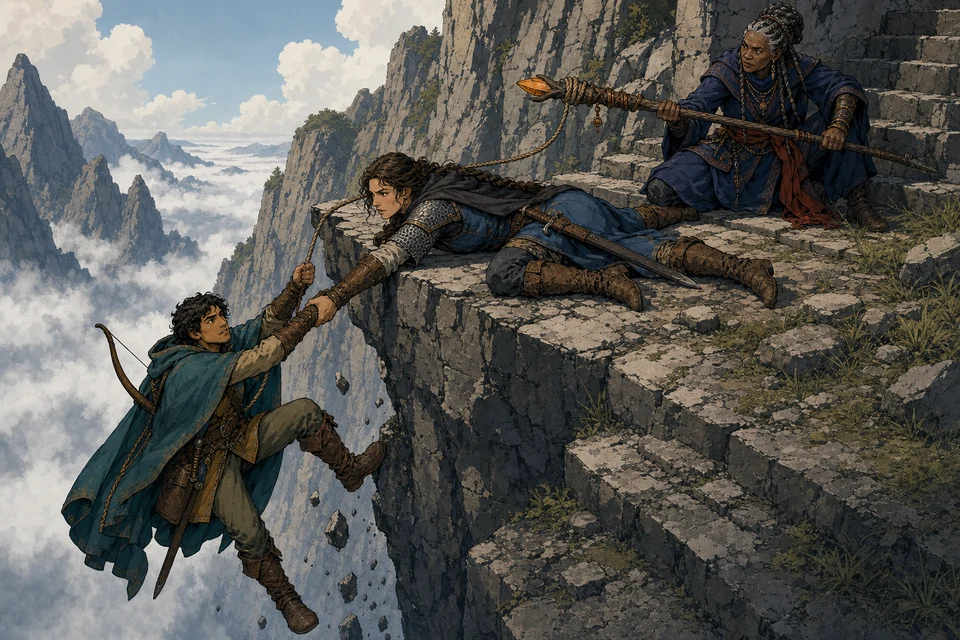
A fall deals 1D6 damage per full 3 metres, ignoring armour. A character damaged by a fall lands prone.
If you are conscious, not surprised, and able to control the landing, make one Athletics (Acrobatics) test:
- Success: remove
1D6of damage and avoid landing prone. - Critical: remove
2D6of damage and avoid landing prone. - Failure: take the fall normally.
- Fumble: maximise every remaining damage die.
Damage dice cannot be reduced below zero. Soft ground, deep snow, a sloped canopy, or a similar yielding surface can halve the effective distance before you count dice.
Example. A 100-metre fall deals
33D6. A successful Acrobatics test reduces it to32D6; it does not make the fall survivable.
Suffocation
You can hold your breath for CON Combat Rounds. After that, make a Resilience test each round with a cumulative -1P, up to the normal -3P cap.
On the first failure, you inhale the substance and suffer its effect at once. Apply the effect again at the end of every following round until you reach breathable air; make no further breath tests. Armour does not reduce this damage.
| Inhaled substance | Effect per round |
|---|---|
| Water | 2D6 damage |
| Vacuum | 2D6 damage |
| Thick smoke | 1D6 damage |
| Poison gas | Exposure to the poison; also 1D6 damage if the gas is thick smoke |
After reaching breathable air, make a Resilience test. On a failure, you can only retch or gasp for 1D4 rounds.
Fire and heat
Apply damage each round of direct exposure. Metal armour does not reduce fire or heat damage; other protection applies only when it plausibly insulates against the source.
Shaped fire deals its damage once, when cast, and created magical hazards never deal damage each round. Only fire it ignites in mundane fuel burns on, using this table.
| Intensity | Example | Damage per round |
|---|---|---|
| Flame | Candle | 1 |
| Large flame | Torch | 1D4 |
| Small fire | Campfire | 1D6 |
| Large fire | Scalding steam, bonfire, burning room | 2D6 |
| Inferno | Lava, blast furnace | 3D6 |
Poisons and diseases list a Type, Delay, Potency from 10 to 100, Effect, and, where needed, Duration. Roll Potency like a skill, in an opposed test against the victim’s Resilience.
Poison
After the Delay, make one opposed test of Resilience against Potency. If the victim wins, the poison has no effect. If the poison wins, apply its full Effect for its Duration.
A successful Healing test completed before the resistance test gives the victim +1B on it. Poison still allows only one resistance test.
Gorgon Serpent Venom: ingested or smeared; Delay 1D3 rounds; Potency 34; Effect 1D3 HP damage and -3 CON; Duration 6D10 minutes.
Disease
After exposure and the first Delay, make an opposed test of Resilience against Potency.
- If the victim wins, the disease ends or fails to take hold.
- If the disease wins, apply its Effect, wait another Delay, and test again. Continue until the victim wins.
A successful Healing test gives +1B to the patient’s next resistance test. While the disease is active, its ongoing effects remain and its damage cannot heal. Normal recovery begins after the victim wins.
Magical curing opposes Shaping with Potency and needs an Intensity based on that Potency.
The Shakes: spread by touch; Delay 1D2 days; Potency 50; Effect halves DEX and deals 1D6 damage each day while active.
Attacking objects
An attack on a stationary object usually hits automatically. Roll only when pressure, movement, poor access, or precise placement makes failure meaningful.
Subtract the object’s Armour Points (AP) from damage, then reduce its Hit Points (HP). At 0 HP it is broken, breached, or useless. Repeated blows against stone, iron, or similar hard material can damage ordinary weapons; the Gamemaster warns the player before this risk applies.
Magically created barriers use their Shaping AP and HP, then follow these rules.
| Object | AP | HP |
|---|---|---|
| Boulder | 4 | 40 |
| Castle gate | 4 | 120 |
| Castle wall, 2-metre section | 5 | 250 |
| Hut wall, 2-metre section | 2 | 15 |
| Iron door | 4 | 75 |
| Wooden chair | 2 | 6 |
| Wooden door | 2 | 25 |