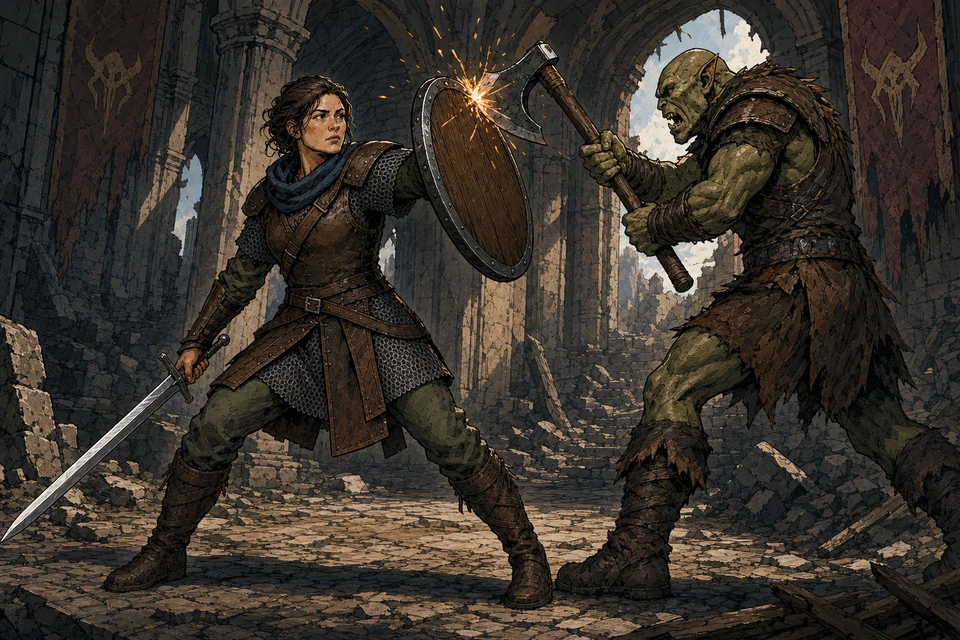
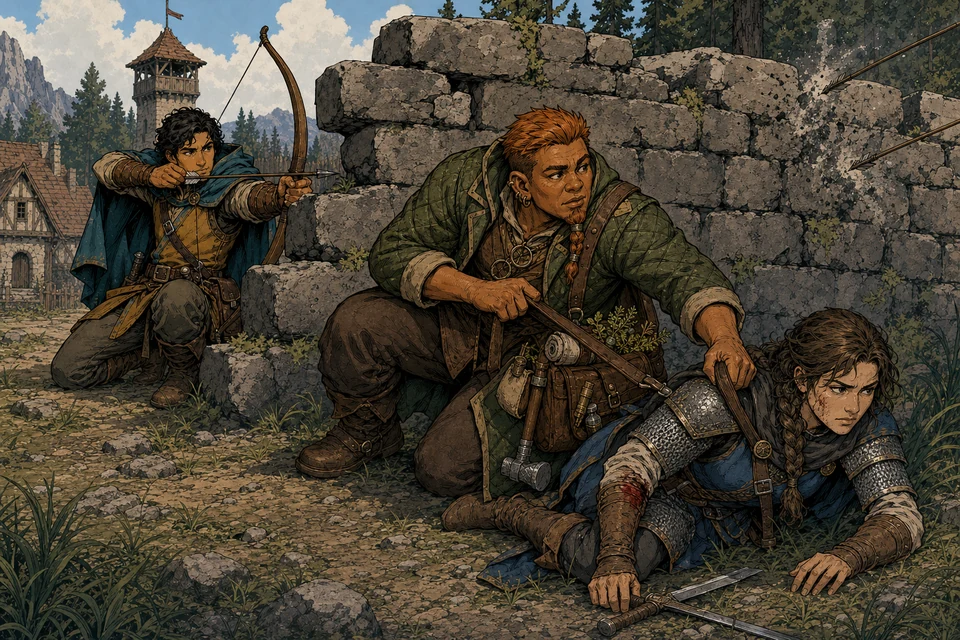
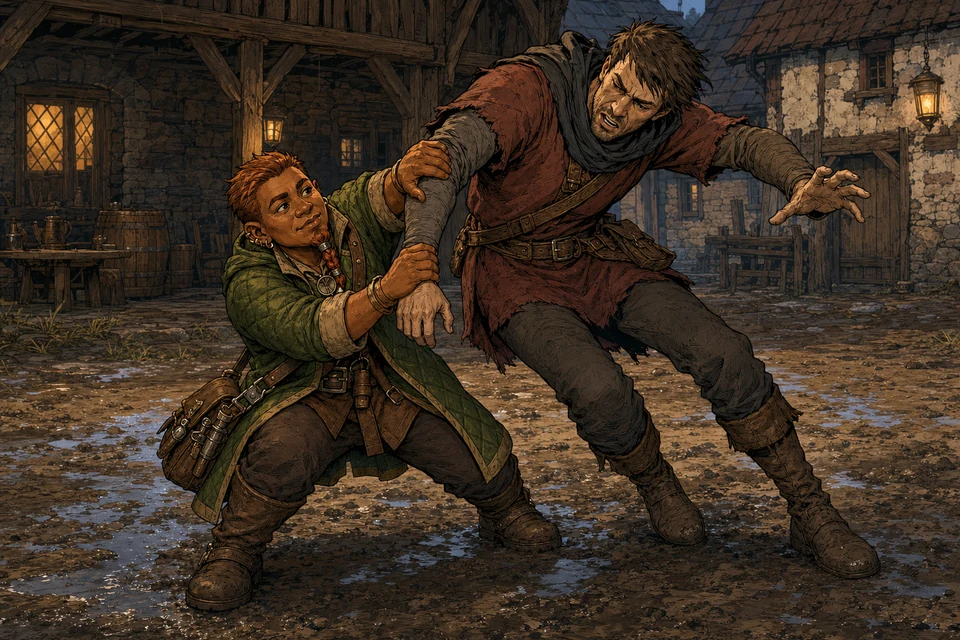
Fast, dangerous fights. Each round you get one action, one move, and one Reaction. Critical hits are decisive and wounds last.
Combat is fast and dangerous. Each five-second round gives you one Combat Action, one Movement Action, and one Reaction. Your Reaction is your defence: once it is spent, even a skilled warrior can be overwhelmed.
Special moves, such as disarming, tripping, rapid shooting, and shield rushing, need Talents.
Each five-second round gives you one Combat Action, one Movement Action, and one base Reaction.
Rounds and Actions. Each five-second round gives you one Combat Action, one Movement Action, and one base Reaction. Also known as action economy, Combat Round, Combat Order, Withdraw, Set Weapon, Intimidate, surrender.
Close means within 2 metres. Anything farther away is Ranged.
Combat Order
When combat starts, everyone rolls 1D10 + Combat Order and acts from the highest total to the lowest. Ties go to the higher DEX. If DEX also ties, reroll 1D10 between those characters.
Your round
A round lasts five seconds and gives you:
one Combat Action, usually an attack or a skill;
one Movement Action; and
one base Reaction, used when something triggers it.
You take your Combat Action and Movement Action in Combat Order. A Reaction interrupts that order only long enough to resolve its trigger. Unused actions are lost; they do not carry into the next round.
You cannot choose an option that would give up or restrict an Action or Reaction already used in a different way. For example, after Parrying this round you cannot Sprint, because a Sprint keeps your Reaction for Dodge only.
Make one standard attack with Close Combat, Unarmed Combat, or Ranged Combat.
Start or escape a grapple.
Aim a ranged weapon.
Set a weapon against a Charge.
Use a skill or object that takes about five seconds.
Cast or maintain a Shaping when its rules need a Combat Action.
Intimidate one enemy or a whole group into surrendering or fleeing.
Delay: act later in the round, after a participant you choose. To interrupt an action that is already starting, make an opposed test with the skills involved; the winner acts first.
Common Movement Actions
Move up to your Movement in metres.
Stand up, or drop prone.
Disengage and move away. An enemy who can reach you can spend a Reaction on an Opportunity Attack.
Ready one item, or nock an arrow, while moving no more than half your Movement.
Stow one item and draw another, or ready two items. This uses the whole Movement Action.
Reloading a crossbow has its own rule; a Ready action never shortens it.
Withdraw
Use your Combat Action and Movement Action to move up to your normal Movement without triggering Opportunity Attacks for that movement. You keep your base Reaction and any extra off-hand Reaction.
Set Weapon
Use your Combat Action to set a ready weapon with the Set tag. If an opponent Charges into its reach before your next turn, you make one Close Combat attack at +1B before their Charge attack is resolved.
The attack costs no further Action or Reaction and works once; then the weapon is no longer set.
It is not a standard attack, so it gives no extra off-hand attack.
Taking any Action, Movement Action, or Reaction before the Charge also unsets the weapon.
Sprint
Use your Combat Action and Movement Action to move up to twice your Movement. That round, your only Reaction is your base Reaction, and you can use it only to Dodge.
Charge
Use your Combat Action and Movement Action, and give up all your Reactions. Move in a straight line, at least 5 metres and at most twice your Movement, along a clear, passable route that ends adjacent to your target. Then make one Close Combat attack; a hit deals +1D6 damage.
You make no other movement that round.
A Charge is not a standard Close Combat attack, so it gives no extra off-hand attack.
Intimidate
Use your Combat Action to demand surrender or drive an enemy off. Choose one target or a whole group, then make an opposed test: your Influence against the target’s Persistence. A group rolls once, using its leader’s Persistence, or the leader’s Influence if higher.
Give the enemy’s roll the one modifier that best describes them; do not add modifiers together.
Enemy’s condition
Modifier
At full strength, or carrying no more than minor wounds
+2B
Outnumbers your side but has lost 20% of its numbers or Hit Points
+1B
Fewer than your side and already wounded
-1P
Has lost over half its Hit Points, or half the group is down
-2P
If you win, the Gamemaster decides how the enemy gives way, judging its condition and numbers:
Wounded enemies, or the wounded members of a group, might flee or surrender.
Enemies at full strength rarely just flee. They are more likely to hesitate and lose a turn.
While the enemy is at full strength or outnumbers your side, only a Critical Influence against a failed Persistence forces a surrender.
If the enemy fumbles its Persistence roll, it breaks and flees at once.
You need no shared language, but you must make yourself understood by sign, gesture, or bearing. The Gamemaster decides who can be targeted and whether the attempt is possible at all.
Attacks and Reactions
Roll your combat skill to hit. If you are hit and aware of it, you can spend a Reaction to Dodge or Parry.
Attacks and Reactions. Roll your combat skill to hit. If you are hit and aware of it, you can spend a Reaction to Dodge or Parry. Also known as attack roll, Dodge, Parry, Opportunity Attack, which defence works, does armour stop magic.
Attacking
Roll D100 against Close Combat for a held weapon, Unarmed Combat for an unarmed or natural attack, or Ranged Combat for a weapon used at a distance. Roll at or under the skill to hit. Bonus and Penalty dice change the roll, not the skill.
Defending
When an attack hits you and you are aware of it, you can spend a Reaction to defend before damage is resolved. Only one Reaction can answer one attack or trigger, even if you have more. A missed attack needs no defence and costs no Reaction.
Which defence works?
Incoming attack
Dodge
Parry with a weapon
Parry with a shield
Armour (AP)
Close weapon or unarmed attack
Yes
Yes
Yes
Yes
Thrown weapon, such as a dagger or javelin
Yes, -1P
Yes, -1P, with Active Guard
Yes, with Active Guard
Yes
Arrow, crossbow bolt, or sling stone
Yes, -1P
No
Yes, -1P, with Active Guard
Yes
Projected Shaping at one target, such as a firebolt
Yes, -1P
No
Yes, -1P, with Active Guard
Yes
Projected Shaping over an area, such as a frost burst
Yes, -1P
No
No
Yes
Direct Shaping, such as searing heat
No
No
No
No: only magical Wards count
Against Direct Shapings, roll Resilience or Persistence instead. This costs no Reaction. See Harm delivery.
Weapon critical hits ignore armour; critical Shapings do not.
Talents change some answers: Missile Guard removes the shield -1P, Shield Cover gives ranged attacks against you -1P, and Counter can stop a Shaping.
Reactions
Dodge: roll Dodge. If you win, the attack misses. Ranged attacks give you -1P. You can Dodge once per round, and only with your base Reaction.
Parry: roll Close Combat with a ready weapon or shield, or Unarmed Combat against an unarmed attack. A winning ordinary Parry reduces damage by Parry Size; a winning critical Parry blocks it all. Parrying a ranged attack needs Active Guard.
Opportunity Attack: make one Close Combat attack when an adjacent enemy disengages or gives you another clear opening. It never gives an extra off-hand attack.
Rolling the defence
Your defence is an opposed test against the original attack roll; the attacker never rolls again.
Each side applies its own Bonus and Penalty dice.
Compare grades: Critical beats Success.
With the same successful grade, the higher roll wins.
On equal rolls, the higher unmodified base skill wins, then the defender.
A failed defence never stops a successful attack.
Exception: critical attacks. An ordinary successful Dodge or Parry turns a critical attack into an ordinary hit, even though the attack wins by grade. Roll normal damage with its usual bonuses, then subtract armour; your Reaction does not avoid or reduce it. If both rolls are critical, compare them normally: a winning critical defence blocks everything, and a winning critical attack keeps its critical damage. See the combat result matrix.
Grappling and Shaping use plain opposed tests, without this exception. A Dodge or Parry against a grapple’s initial seizure still spends one eligible Reaction and counts toward the normal Dodge limit. That roll is part of the grapple test, not a second roll.
Parry Size
After a winning Parry, compare the attacking weapon’s Size with your parrying item’s.
Your parrying item is…
Damage blocked
The same Size or larger than the attack
All
One Size smaller
Half
Two or more Sizes smaller
None
Any Size, when your critical Parry wins
All
Sizes run Light → Medium → Heavy → Huge. Unarmed attacks and bow, crossbow, and sling projectiles are Light. Natural weapons use their listed Size, or Medium if none is listed. Thrown weapons keep their listed Size.
A blocked half rounds up, like every half. A losing Parry blocks nothing, even when it demotes a critical. Subtract armour after the Parry.
Special techniques
Disarming, tripping, subduing, shield rushing, and trading defence for extra attacks each need a Talent.
Active Guard
Parry a thrown weapon, a missile, or a Projected Shaping aimed at you. Most of these need a ready shield.
Active Guard. Parry a thrown weapon, a missile, or a Projected Shaping aimed at you. Most of these need a ready shield. Also known as missile Parry, shield against arrows, active shield defence, parry a firebolt.
Active Guard is a Parry against a ranged attack. After a ranged attack or individually targeted Projected Shaping succeeds against you, you can React with Active Guard before resolution, if you are aware and have an eligible item ready.
Using Active Guard
Incoming attack
Eligible Parry
Modifier
Thrown weapon
Ready weapon
-1P
Thrown weapon
Ready shield
None
Bow, crossbow, or sling projectile
Ready shield only
-1P
Individually targeted Projected Shaping
Ready shield only
-1P
Roll Close Combat with the item.
Against a mundane attack, oppose the original attack roll and use the critical matrix, as for a normal Parry. Parry Size applies only after a winning Active Guard. An ordinary successful Active Guard still turns a critical into an ordinary hit, but blocks no damage.
Against a Projected Shaping, oppose Close Combat against the Shaper’s original Shaping result. If you win, compare your shield with the Shaping’s Impact Size.
With an off-hand item, you can use your extra off-hand Reaction for Active Guard. Its -1P adds to the modifier above.
Limits
Arrows, crossbow bolts, and sling stones are Light. Shields are Medium (small), Heavy (medium), or Huge (large), so a winning ordinary Active Guard with any shield blocks them completely. Thrown weapons keep their listed Size.
Weapons cannot Active Guard Projected Shapings; only shields can.
A shield is not ready while you wield a two-handed item.
Holding a shield gives attackers no penalty unless you have Shield Cover. Terrain cover is separate.
Missile Guard removes the -1P when you use a shield.
Ranged Combat
Shoot or throw within your weapon's Range, or up to twice that at a penalty. Cover and conditions give Penalty dice; crossbows take time to reload.
Ranged Combat. Shoot or throw within your weapon's Range, or up to twice that at a penalty. Cover and conditions give Penalty dice; crossbows take time to reload. Also known as missile combat, range bands, cover, crossbow reload.
Make a Ranged Combat test against a target within your weapon’s listed Range.
Up to Range: attack normally.
Beyond Range, up to twice Range: attack at -2P.
Farther than twice Range: you cannot hit the target.
Damage and close range
Thrown attacks add your Damage Modifier. Bows, crossbows, and slings deal only their listed damage, unless a Talent says otherwise.
Within 2 metres, a ranged weapon with the Close tag attacks with Close Combat. Any other ranged weapon becomes an improvised Light club there: 1D6 + DM, attacking at -1P.
Defending against ranged attacks
An aware target can Dodge at -1P, or meet thrown attacks and physical projectiles with Active Guard.
Aim
Use your Combat Action to aim at one target you can see. Your next ranged attack against it gains +1B, unless you first take any Reaction, lose sight of the target, or fail to make that attack with your next Combat Action.
Cover
Cover penalises the attack; it does not reduce damage.
Cover
Modifier
Partial, such as a low wall
-1P
Substantial, such as battlements
-2P
Complete: no attack line reaches the target
Attack prevented
Terrain cover and the Shield Cover Talent do not add together; use only the better penalty.
Common Situational Modifiers
Illumination has its own vision penalty, separate from the obscurity rows below.
Situation
Modifier
Target moved at least 10 m since the attacker’s last turn
-1P
Target moved at least 30 m since the attacker’s last turn
-2P instead
Target partly obscured by mist, smoke, fog, or foliage
-1P
Target heavily obscured by mist, smoke, fog, or foliage
-2P instead
Target is prone
-1P
Target is helpless
+2B
High wind
-1P
Fierce wind
-3P
Hurricane
Attack fails
Attacker is prone
-2P
Attacker is on unstable ground
-1P
Attacker is engaged at Close range
-2P per enemy
Use only the strongest row for the same condition, such as movement, obscurity, or wind. Modifiers from different causes add together, up to the normal +3B or -3P limit.
Crossbows
Light crossbow: reloading uses your Movement Action and base Reaction.
Heavy crossbow: reloading uses the whole round: Combat Action, Movement Action, and all Reactions.
A generic Ready action never shortens either reload.
Firing Into a Crowd
Apply cover as normal. An ordinary failure simply misses. Only a fumble can hit someone else: a nearby target chosen fairly or at random, which takes normal rolled damage after armour.
Grappling
Seize a target with Unarmed Combat; it can spend a Reaction to Dodge or Parry. Once held, it escapes with an opposed Unarmed Combat test.
Grappling. Seize a target with Unarmed Combat; it can spend a Reaction to Dodge or Parry. Once held, it escapes with an opposed Unarmed Combat test. Also known as grapple, break free, wrestling, parry a grapple.
Establish and escape
Only one controller can hold a target at a time.
Seizing. Spend a Combat Action to seize an adjacent target. You need at least one free, usable grasping limb. Before the test, commit one limb, and you can commit a second.
Defending. An aware target can spend one eligible Reaction to oppose your Unarmed Combat with Dodge or Parry. It must declare and spend the Reaction before rolling the opposed test; that defence roll is the Reaction, not an extra roll afterward.
Dodge: spends the base Reaction and counts toward the once-per-round Dodge limit.
Parry: spends an eligible Reaction, using Close Combat with a ready weapon or shield, or Unarmed Combat with nothing in hand. An extra off-hand Parry follows its normal item restrictions and -1P.
No defence. If the target is unaware, cannot spend an eligible Reaction, or chooses not to defend, you make an unopposed Unarmed Combat test. A success establishes the hold; a failure or Fumble does not. No Reaction does not mean an automatic hold.
Weapon Parry. If the target wins the contest with a successful weapon Parry, the hold fails and the weapon deals you 1 HP, ignoring AP. This applies only to an attempt to establish a hold. A failed weapon Parry that still wins the opposed test deals no damage, and neither does a shield or unarmed Parry.
The hold. A failed attempt to establish the hold leaves your limbs free. If you win the opposed test, or succeed unopposed, you are the controller and the target is the held participant. While the grapple lasts, both of you:
cannot take a Movement Action;
suffer -1P on every test; and
can attack or Parry only with Unarmed Combat or a ready Light one-handed weapon.
A committed limb is occupied: it cannot attack or Parry, and it does not count toward an off-hand option.
Limbs and Leverage
You can commit a second usable limb before an establishment test. During a grapple, either participant can add or release a second committed limb freely at the start of their own turn. While committed, a second limb gives +1B on establishment, escape, Wrestler, and opposing grapple tests.
The held participant commits one free, usable limb the first time they make an escape, Wrestler, or opposing grapple test; that first limb gives no bonus.
The controller cannot release their last committed limb without ending the grapple. All committed limbs become free when the grapple ends.
Escape, release, and assistance
Only the controller can release the grapple freely, on their own turn. The held participant must escape: spend a Combat Action and win an opposed Unarmed Combat test against the controller. Opposing an escape or a Wrestler test within an established hold spends no Reaction; only a Dodge or Parry against the initial seizure costs one.
The grapple ends on a successful escape, a separation, the controller’s incapacitation, or the loss of the controller’s last committed limb. After an ordinary release or escape, both stay adjacent.
Helpers. A target already held by one controller cannot be independently grappled. Adjacent helpers can instead give combined Assistance on one grapple test, using the normal Assistance rules. Each helper commits one usable limb for that test, and a helper never becomes the controller.
Size and Circumstances
Size, anatomy, footing, and similar circumstances are for the Gamemaster to judge.
One clear circumstance gives one side either +1B or -1P, never both Bonus and Penalty dice for the same circumstance.
An overwhelming difference can be worth +2B, +3B, -2P, or -3P, or make the attempt impossible.
The second limb’s +1B is separate from this judgement.
The Wrestler Talent adds damaging holds, forced drops, and throws.
Fighting With Off-Hand Options
With two ready one-handed items, each round you can make one extra attack or keep one extra Parry or Opportunity Attack, both at -1P. Never both.
Fighting With Off-Hand Options. With two ready one-handed items, each round you can make one extra attack or keep one extra Parry or Opportunity Attack, both at -1P. Never both. Also known as off-hand attack, two-weapon fighting, fighting with two ready items, weapon and shield, extra Parry.
Choose One Option
If you hold two ready one-handed items, you can use one of these options once per round. An empty hand counts, because a punch or kick is a weapon when you attack. So a weapon and a free hand qualify, as do a weapon and a shield, or two bare hands. A two-handed item leaves no hand free.
Extra attack: right after a standard Close Combat or Unarmed Combat attack, make one free attack at -1P with your other item, or unarmed with your free hand. It costs no Action or Reaction. Add your Damage Modifier to both attacks as normal.
Extra off-hand Reaction: keep your other item ready for one extra Parry or Opportunity Attack at -1P. The Parry can be an Active Guard, which adds its own modifier.
Once you use either option, the other is unavailable until the next round. You keep your base Reaction either way.
Limits
The extra Reaction cannot be used to Dodge or to activate Protector.
Any rule that takes away all your Reactions also takes away the extra Reaction.
An Opportunity Attack never gives an extra off-hand attack.
Off-Hand Mastery removes the -1P from both options, but gives no extra uses and does not allow both in one round.
Critical Hits and Fumbles
A critical attack beats an ordinary Reaction; only a critical Reaction stops it completely. A fumble brings one fitting setback.
Critical Hits and Fumbles. A critical attack beats an ordinary Reaction; only a critical Reaction stops it completely. A fumble brings one fitting setback. Also known as critical matrix, combat results, fumble.
An attack is critical when it succeeds with a D100 roll at or under the tens digit of your skill. Skill 59 is critical on 01–05 and skill 100 on 01–10; any skill above 0% is critical on at least 01. See exact critical ranges.
A roll of 99 or 00 is a fumble if your skill is below 100%; at 100%, only 00 fumbles. A fumble overrides success.
Deadly Precision doubles your normal critical range for one declared, eligible damaging attack each round. Use that wider range when grading Bonus or Penalty dice candidates; the result still uses the matrix below.
Combat Result Matrix
Compare the original attack and defence as an opposed test. The one special case is an ordinary defence against a critical attack, which demotes the hit.
Against an ordinary hit
Defence
Result
None, failed, or losing ordinary defence
Normal damage with eligible bonuses, then armour.
Winning ordinary Dodge
No damage.
Winning ordinary Parry
Reduce damage by Size, then armour.
Critical Dodge or Parry
No damage. A critical Parry ignores Size.
Against a critical hit
Defence
Result
None, failed, or losing critical defence
Maximum weapon damage, plus maximum positive DM when it applies. Ignore armour and other damage bonuses.
Ordinary successful Dodge or Parry
Demoted to an ordinary hit: normal damage with eligible bonuses, then armour. The defence neither stops nor reduces it.
Winning critical Dodge or Parry
No damage. A critical Parry ignores Size.
Critical damage
A hit that stays critical:
deals maximum weapon damage, plus the maximum of a positive Damage Modifier when DM normally applies;
ignores armour;
gains no extra damage dice or fixed damage bonuses from Actions or Talents; and
ignores a negative Damage Modifier.
A critical demoted to an ordinary hit uses all the normal damage rules instead, including eligible bonuses and a positive or negative Damage Modifier. The demotion only decides the damage: do not resolve the Reaction again, and grant no extra attack or manoeuvre.
A critical hit grants no free manoeuvre, attack, or Talent. If a Talent declared before the roll replaces damage with another effect, follow the Talent; the critical adds nothing.
Fumbles
On a fumble, the Gamemaster applies one immediate consequence that fits the risk, such as falling prone, dropping or damaging equipment, being exposed, or endangering someone nearby. Avoid consequences that decide a whole fight regardless of the situation. Firing into a crowd has its own fumble rule.
Damage and Wounds
One hit that reaches your Major Wound Level after armour leaves you Wounded and Bleeding. At 0 HP you are unconscious and Dying.
Damage and Wounds. One hit that reaches your Major Wound Level after armour leaves you Wounded and Bleeding. At 0 HP you are unconscious and Dying. Also known as Major Wound, Bleeding, Dying, Surgery.
Damage steps
When an attack hits:
Roll damage: weapon damage, plus Damage Modifier when it applies, plus any extra dice or fixed damage from the declared action or Talent.
Parry: if the defender won a Parry, reduce the damage by Parry Size.
Armour: subtract the target’s Armour Points.
Vitality reserve: a vitality reserve absorbs damage next. Apply it after every other applicable reduction, just before actual HP.
Lose HP: reduce current HP by what is left. Neither damage nor current HP goes below 0.
Example. An ogre’s Heavy club hits you for 12 damage. Your arming sword is Medium, one Size smaller, so your winning Parry blocks half: 6 remain. Your leather armour (2 AP) stops 2 more. You lose 4 HP.
Critical hits change these steps, as their matrix shows.
Damage Modifier applies to Close Combat, Unarmed Combat, and thrown attacks, not to bows, crossbows, or slings unless a Talent says otherwise.
Major Wounds
When one hit deals damage at least equal to the target’s Major Wound Level (MWL) after armour, apply the HP loss and both of these conditions:
Wounded:-1P on every test.
Bleeding: lose 1 HP at the end of every Combat Round.
Only damage that passes a vitality reserve and reaches actual HP counts toward a Major Wound.
These conditions do not stack. A further Major Wound still deals its damage and can restart Bleeding after it was removed, but creates no separate wound to track.
Do not make a Resilience test or roll on an injury table for a Major Wound.
Dying
At 0 HP, you fall unconscious and are Dying. If you are still Dying at the end of the third Combat Round after reaching 0 HP, you die.
Stabilising. An adjacent helper spends a full round (Combat Action, Movement Action, and all Reactions) and succeeds at a Healing test, while both stay where they are. The test needs a Healing Kit or suitable improvised supplies, or is at -2P. Success removes Bleeding and Dying but restores no HP; a patient at 0 HP stays unconscious.
After stabilising. Successful Surgery or equivalent treatment restores 1 HP and lets natural recovery begin. Wounded ends after that treatment once current HP is greater than MWL. See healing and recovery.
Hero Points
Prevent a Major Wound: when a hit would cause one, spend 1 Hero Point. You still lose the full HP, but the hit causes no Wounded or Bleeding; it counts as ordinary damage, with no Major Wound for Surgery to treat.
Avoid Death: at 0 HP, spend 1 Hero Point. You become stable and unconscious instead of Bleeding or Dying, and wake after the scene at 1 HP, still Wounded if you were already.
These are separate uses: if the damage you kept takes you to 0 HP, avoiding death costs another Hero Point.
Position and Mounted Combat
Flanking, footing, visibility, higher ground, and mounts give Bonus or Penalty dice instead of separate rules.
Position and Mounted Combat. Flanking, footing, visibility, higher ground, and mounts give Bonus or Penalty dice instead of separate rules. Also known as flanking, higher ground, darkness, mounted combat.
Use a modifier only when the situation clearly calls for it. Modifiers from different causes add together, up to the normal +3B or -3P limit.
Close Combat situation
Modifier
Target is helpless
Automatic critical
Target is prone, flanked, or attacked from behind
+1B to attack
Attacker or defender has higher ground
+1B to that side
Attacker or defender is prone
-1P to that side
Unstable ground
-1P
Underwater
-2P
Partial darkness
-1P
Darkness
-2P
Blinded or in pitch black
-3P
The higher-ground and prone modifiers apply to that character’s own rolls. So a prone defender gives the attacker +1B and takes -1P on its own Reaction. The darkness rows use the light levels in Light and Darkness.
Awareness
An unaware defender cannot React. Being behind or beside a target does not by itself make it unaware; the fiction decides awareness. Battle Awareness can cancel the flanking or rear-attack bonus, but not genuine surprise.
Mounted Combat
A mounted combatant gains +1B on Close Combat attacks and Parries against an adjacent opponent on foot. That opponent suffers -1P on Reactions against the rider.
Neither modifier applies if the opponent on foot is as tall as the mounted combatant, or uses a weapon at least two Sizes larger than the rider’s weapon.
Use the mount’s Movement instead of the rider’s.
On a Charge with a lance, use the mount’s Damage Modifier instead of the rider’s.
A mounted character’s weapon skill cannot be higher than their Riding skill.
Mounts unused to battle. At the start of each round, the rider tests Riding. On a failure, the mount Sprints away at its first opportunity that round.