Freeform magic. Combine a Technique and a Form you know, rate the effect's dials, then cast it with your Shaping skill and Power Points.
Shaping is freeform magic: describe what you want, price it with a few numbers, and roll.
Cells. A Technique is what magic does, such as Unmake; a Form is what it works on, such as Fire. Together they make a cell, written Technique·Form: Unmake·Fire. You cast only with cells you know, normally one per Shaping; the Confluence Talent permits exactly two.
Dials. For each outcome, rate its Intensity (strength) from 0 to 5. Then rate the shared Range (distance), Duration (time), and Reach (number, area, or size) once.
Magnitude. The dials plus any adjustments add up to Magnitude, which sets the PP cost and the risk.
Casting. Spend a Combat Action and roll Shaping. On a success, pay Magnitude in PP; the target can still defend.
Limits. Casting above your Safe Magnitude is risky, and all your ongoing Shapings together cannot exceed your permanent, unmodified INT.
Buy the 20 IP Shaping Talent. It gives you the Shaping skill, one specialty, two known cells, and the Sense Magic and Dispel actions.
Becoming a Shaper. Buy the 20 IP Shaping Talent. It gives you the Shaping skill, one specialty, two known cells, and the Sense Magic and Dispel actions. Also known as Shaper creation, learn magic, Technique Form cells.
Access
The Shaping Talent costs 20 IP and requires a supernatural initiation or discovery. It gives you:
Shapers learn exact cells, not whole Forms or Techniques: knowing Unmake·Fire gives no other Unmake or Fire cell. Choose cells from Forms and Techniques.
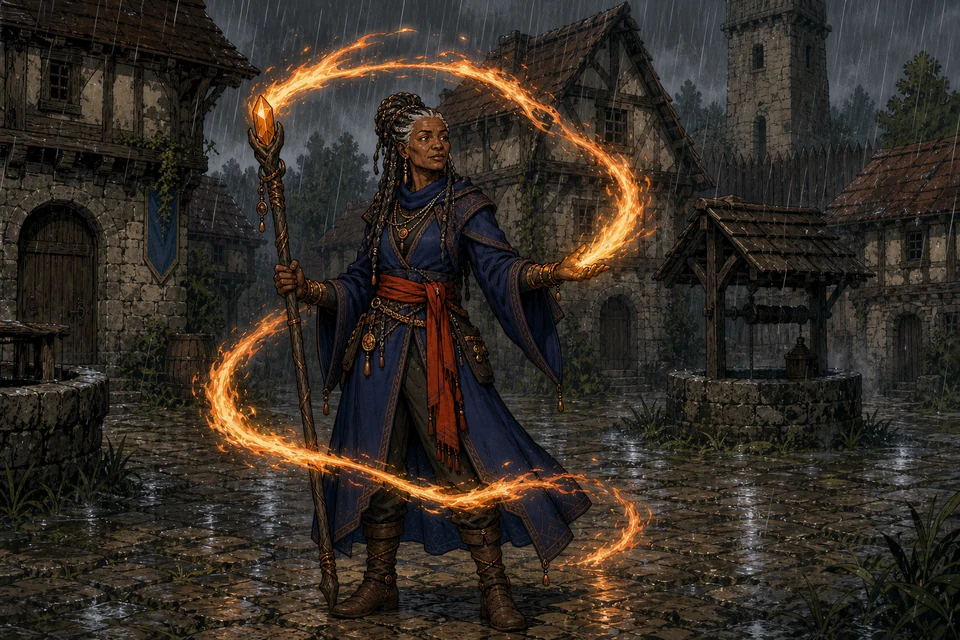
Example. Ilyra’s specialty is Fire, so both her starting cells contain Fire: Unmake·Fire and Ward·Fire.
At character creation
You can buy the Talent during character creation or later. At creation, declare the Talent and reserve its 20 IP before skill point allocation. Shaping starts at its normal base of INT + POW, and you can spend up to 30 Knowledge points on Shaping.
This remains a real sacrifice, not a discount: you must still spend the full 20 IP, usually by trading other skill points for Improvement Points.
INT and POW
INT and POW both establish the Shaping skill. After that, permanent, unmodified INT limits total Active Magnitude, while POW sets maximum PP: INT is how much magic you can keep going, POW the fuel you spend.
Improving
Shaping caps at 100% and improves normally, at most once between adventures. Learning more cells needs suitable experience.
Advancement
IP
New cell containing the specialty
2
Any other cell; needs a significant ordeal or a master
4
Improve Shaping
1; use normal skill gain
Practice and Tell
Every Shaper defines:
Practice: what you visibly do to cast, such as speech, gestures, a focus, prayer, or trance. It can be interrupted; if it is prevented, you cannot cast.
Tell: an unavoidable sign around you and any ranged target or area. It reveals magic, not its purpose.
Anyone watching the Practice notices the Tell. It is also automatically noticeable within 10 × Magnitude metres of you and the target, minimum 3 metres. Cosmetic style is free; concealing the Tell requires the Veiled Talent.
Building a Shaping
Before you roll, choose a known cell and price each outcome.
Building a Shaping. Before you roll, choose a known cell and price each outcome. Outcome Intensities + Range + Duration + Reach + adjustments = Magnitude. Also known as Magnitude, magic formula, Shaping dials, Shaping limits, rules for every Shaping.
Build a Shaping before you roll:
Choose a known cell. Every outcome must use that cell unless you apply Confluence to combine exactly two known cells.
Rate each outcome’s Intensity. An outcome is one thing the Shaping does, such as damage or healing.
Rate the shared Range, Duration, and Reach once.
Add adjustments, such as Direct Harm, and total the Magnitude.
Core formula:sum of outcome Intensities + Range + Duration + Reach + adjustments = Magnitude.
Intensity sets each effect; Magnitude sets PP, difficulty, active load, and Dispel strength. Your casting result sets what you pay. Declare the Shaping in one sentence for the Gamemaster to confirm:
Using [Technique]·[Form], I cause [outcome] at [Range], affecting [Reach], for [Duration].
For immediate Unmake damage, declare its delivery before calculating Magnitude: Projected or Direct.
Intensity
For each outcome, choose the lowest row that covers it; Effects gives exact benchmarks. Practical effects need Intensity 1 or more.
Intensity
Degree
Benchmark
0
Trick
Cosmetic; no practical benefit.
1
Minor
Ordinary action or tool: small change, hindrance, clue, or movement.
2
Potent
Specialist: harm, restraint, +1B/-1P, useful creation, or moving a person.
3
Major
Superhuman: flight, lost Combat Action, essential transformation, distant observation, or competent summon.
4
Greater
Encounter-changing: control, +2B/-2P, impossible transformation, or major threat.
5
Mythic
Break a fundamental boundary; ritual and lasting price required.
Tricks. A calm Magnitude-0 Trick is free and automatic. Under pressure, a failed Trick does nothing, and a fumble causes only an inconvenient Tell: no PP loss or Backlash. Other Tricks cast normally.
Your limits
Your Shaping expertise limits both maximum Intensity and Safe Magnitude. No individual outcome can exceed maximum Intensity. Casting above Safe Magnitude is overreach: harder, and dangerous if it fails.
Shaping
Expertise
Maximum Intensity
Safe Magnitude
Highest Magnitude without a ritual
Highest Magnitude with a ritual
0–25%
Novice
1
1
3
3
26–50%
Apprentice
2
2
4
4
51–75%
Veteran
3
3
5
6
76–99%
Expert
4
4
6
8
100%
Master
5
5
7
10
The last two columns follow from the overreach and ritual rules. Normal casting reaches Safe Magnitude + 2; a ritual reaches Safe Magnitude + 2 or twice Safe Magnitude, whichever is greater.
Rituals and contributed PP cannot raise maximum Intensity, and the Shaping Expertise Talent raises neither limit. Lasting magic has a third limit: total Active Magnitude cannot exceed INT.
Range
Rating
Range
0
Self or touch
1
Within 15 metres
2
Within 50 metres
3
Any visible point
4
Familiar, marked, or mystically linked target in the same realm; ritual
5
Another realm or plane; mythic ritual
Range 1–3 needs an unobstructed route. Indirect crosses a barrier when the Form permits.
Duration
Rating
Duration
0
Instant or until the end of the affected subject’s next turn
1
One scene or 10 minutes
2
Until the target next fully rests, maximum 8 hours
3
One week; ritual
4
Indefinite until dismissed or Dispelled; ritual
5
Permanent; mythic ritual
Duration sustains a state, sense, or observation, not repeated damage, healing, lost Actions, discrete answers, or other one-use outcomes. Concentration beyond your next turn requires Duration 1 or more.
Reach
Use the highest rating that the number of targets, the area, or the largest subject requires.
Rating
Targets or area
Largest subject
0
One
Person, door, or human-sized object
1
Up to 2 or 3-metre radius
Wagon or large tree
2
Up to 5 or 10-metre radius
Room-sized structure
3
Up to 20 or 50-metre radius
Building or ship; ritual
4
Up to 100 or 500-metre radius
Settlement; ritual
5
Army, city, or region
Landscape-scale; mythic ritual
An area includes everyone in it, allies too. Leaving out chosen subjects requires Selective.
Reach cannot let a low Intensity demolish or transform beyond its benchmark.
Adjustments
Anything beyond Intensity, Range, Duration, and Reach is an adjustment that adds Magnitude. Shared Range, Duration, and Reach count once, however many outcomes there are.
An additional outcome within the same known cell needs no training. Price each outcome at its own lowest applicable Intensity, then sum each outcome’s Intensity.
Outcomes must be distinct and permitted by the cell.
One Shaping cannot repeat damage, healing, movement, restraint, control, or another cumulative outcome on one subject. Use a higher Intensity for a stronger effect.
Example. Healing at I3 plus a Resilience bonus at I2, at touch with no other dials, is M5. Alter·Flesh can combine those outcomes, but cannot buy healing twice.
Trigger
A Trigger fixes its target, cell, outcomes, Range, Reach, and all other dials when it is armed; it cannot defer those choices until it fires. The Trigger Talent covers weapon hits and enchanted items.
Rules for every Shaping
Price outcomes, not descriptions. Use the lowest Intensity that covers each outcome. Magic can rival a specialist through PP and risk, but not erase skills, equipment, or preparation.
Duration never repeats. One-use outcomes, such as damage, healing, lost Actions, and answers, happen once; see Duration.
Damage is dealt once. It never recurs each round, adds to every weapon hit, or retaliates when a protected subject is attacked or harmed; see Damage.
Consequences are real, not free. A pushed foe can fall, but no consequence can hide free damage, modifiers, conditions, or resources.
Same-kind magic does not stack. Use only the strongest same-kind magical modifier, armour, or protection. Mundane circumstances still combine under the +3B/-3P cap.
No extra actions or resources. Shaping never widens a critical range or grants extra Combat Actions, Movement Actions, Reactions, Dodges, PP, IP, Hero Points, Talents, skills, or memories.
Only Dispel ends active magic. Unmake can damage a manifestation or exploit a genuine natural counter, but only Dispel directly ends an active Shaping.
Created matter is temporary. It vanishes when its Duration ends; see temporary matter.
Casting and Defence
Spend one Combat Action and roll Shaping. Resolve any Counter and the target's one defence, pay PP, then apply the effect.
Casting and Defence. Spend one Combat Action and roll Shaping. Resolve any Counter and the target's one defence, pay PP, then apply the effect. Also known as cast magic, resist magic, magic Backlash, magical shields, does armour stop magic, can a shield block a firebolt.
Cast
Declare the cell and outcomes. Set each outcome’s Intensity, then the shared Range, Duration, Reach, and adjustments.
Confirm. The Gamemaster confirms Magnitude, modifiers, defence, armour, and consequences.
Check limits. Your PP, or ritual pledges, must cover the Magnitude; an indefinite ritual’s leader needs that much current and available maximum PP. The Shaping must fit your Active Magnitude limit.
Roll. Spend one Combat Action and test Shaping, keeping your Movement Action and eligible Reactions.
Resolve. Resolve any Counter and defence, pay PP, then apply the effect.
Casting requires your Practice, your Tell, a valid target, and line of effect, unless Scry, Indirect, or ritual Range says otherwise. If your Practice is prevented, you cannot cast.
Safe Magnitude and overreach
Casting above your Safe Magnitude is overreach. Normal casting reaches at most Safe Magnitude + 2.
Magnitude compared with Safe
Casting modifier
No greater
None
1 higher
-1P
2 higher
-2P
3+ higher
Ritual required
Cancelling or removing the Penalty does not remove overreach. Shaping Expertise can remove one remaining Penalty die from a casting test once per round, but failed overreach still causes its normal PP loss and Backlash.
Results and cost
Casting result
Outcome
Critical
Success; pay half Magnitude. Critical grade applies, but effect dice are not maximised.
Success
Pay full Magnitude.
Failure within Safe Magnitude
No effect; lose 1 PP.
Failed overreach
No effect; lose half Magnitude and suffer Backlash.
Fumble
No intended effect; lose full Magnitude and suffer Backlash.
Half Magnitude rounds up. A successful casting that a defence stops still pays its full cost. Resolve any Hero Point reroll before PP loss or Backlash. A casting that drops you to 0 PP resolves its effect before you fall unconscious; any concentration then ends.
Harm delivery
Projected Harm crosses space, like a missile. Direct Harm arises inside its target. Declare which before calculating Magnitude; Projected Harm and Direct Harm are mutually exclusive, whatever their description.
Delivery
Cost
Opposed defence
Protection
Projected Harm
—
Dodge or shield Active Guard
Cover and nonmagical AP
Direct bodily or material Harm
+1 M
Resilience
Magical Wards and named resistance
Direct mental or spiritual Harm
+1 M
Persistence
Magical Wards and named resistance
Direct Harm to unattended objects
+1 M
None
Magical protection only
A successful resistance that wins the opposed test negates the entire Direct outcome; it does not reduce the damage.
Direct Harm permits selected-target Reach, never a radius.
Each Direct target needs a valid Range route; a complete barrier requires Indirect.
Defence
Each hostile outcome receives exactly one defence against the original Shaping result. Harmful outcomes use the delivery table above. Other hostile outcomes use this table, without the Direct Harm adjustment:
Other effect
Opposed defence
Self, willing subject, unattended object, point
None
Individually targeted Projected Shaping
Dodge or shield Active Guard
Projected or otherwise avoidable area
Dodge
Bodily or material alteration, restraint, or physical control
Resilience
Thought, emotion, memory, identity, soul, or control
Persistence
How the defence is rolled
Dodge, shield Active Guard, Resilience, and Persistence each oppose the original Shaping result as an opposed test. That original Shaping result is the attacker’s skill roll; the Shaper does not roll again.
The Shaper must succeed and win against Dodge, Resilience, or Persistence for that subject to be affected.
If shield Active Guard wins, apply Parry Size (see Cover and shields); if Shaping wins, the guard has no effect.
Dodge and shield Active Guard take -1P. Dodge spends only the base Reaction, once per round. Resilience and Persistence spend no Reaction.
A magical Critical keeps its grade for the opposed test. If Shaping wins, use normal effect dice and armour, not weapon-critical benefits.
Resolve defence rolls per subject. Against one subject, outcomes using the same defence share one defence roll; outcomes using different defences resolve separately. Different subjects always defend separately.
Counter
The defender chooses one eligible Reaction: Counter, Dodge, or Active Guard. Counter comes before the target’s defence and opposes the Shaping. A character who Counters cannot then Dodge, Active Guard, or oppose with Resilience or Persistence. Another character’s Counter does not use up the target’s defence.
Touch Shapings
A hostile Touch Shaping first needs a no-damage Unarmed Combat attack to make contact. This is the sole defence exception: the target defends against the touch, then resists the Shaping as normal.
No Talent or off-hand attack applies to the touch. The target can React; contact succeeds unless the combat matrix stops the hit, and a partial Parry does not.
A failed touch spends the Combat Action, with no Shaping roll and no PP loss. After contact, cast and resolve resistance as normal; a Critical touch adds nothing.
Areas
Areas share one Shaping roll, but unwilling subjects defend separately.
An aware subject can Dodge a projected area at -1P, gaining no movement or prone.
Attended objects use their bearer’s defence.
In an ongoing area, a subject defends when first affected and the result is stored. Leaving suspends the effect; re-entering grants no new defence.
Cover and shields
Cover. Terrain between you and the target of a Projected Shaping gives partial cover -1P or substantial cover -2P; complete cover prevents casting without another route or Indirect. Selected targets use their greatest cover penalty for the one roll. Areas test cover to the chosen point. Occupants’ shields do not alter the area’s shared roll.
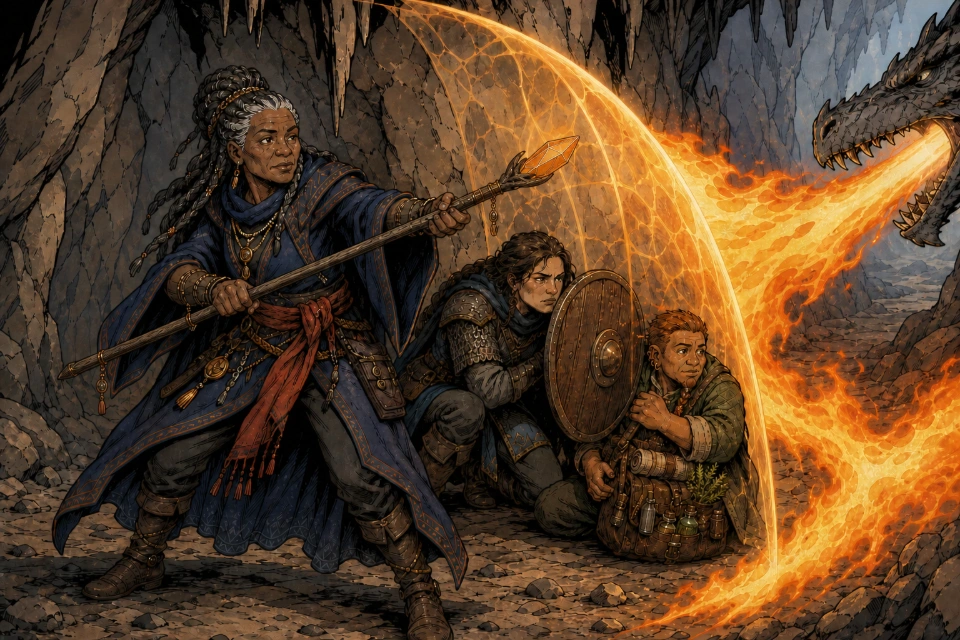
Shield Cover. The Shield Cover Talent affects every individually targeted Projected Shaping, regardless of Form or whether solid or non-solid. Apply it before Active Guard, and use only the better of Shield Cover or terrain.
Active Guard. An individually targeted projection can be Active Guarded at -1P with a ready shield. Weapons cannot Active Guard magical projections. Areas cannot be Active Guarded. Direct Harm and Spirit Harm cannot be Active Guarded. Missile Guard removes the penalty.
Impact Size
Each Projected outcome uses its own Intensity to set its Impact Size. When several outcomes share one winning shield Active Guard roll, apply Parry Size to each outcome separately.
Intensity
Damage
Impact Size
1
1D6
Light
2
2D6
Medium
3
3D6
Heavy
4
4D6
Huge
5
5D6
Beyond Huge
After a winning shield Active Guard, compare the shield’s Size with each outcome’s Impact Size:
Same Size or larger: blocks that outcome’s damage and attached effects. If it deals no damage, it blocks the outcome.
One Size smaller: blocks half that outcome’s damage, rounded up, but a separately paid non-damage outcome remains unless its own Size comparison blocks it.
Two or more Sizes smaller: reduce no damage.
A Critical shield Parry that wins blocks everything regardless of Size.
If Shaping wins the opposed test, the guard has no effect. Even a Critical Shaping rolls normal magical damage, then armour. Shields suffer no item damage merely for guarding.
Shield
Size
I1
I2
I3
I4
I5
Small
Medium
All
All
Half
None
None
Medium
Heavy
All
All
All
Half
None
Large
Huge
All
All
All
All
Half
A separate mundane object attack uses ordinary weapon Size. An attack resolved as Shaping uses Impact Size.
Example: a firebolt
Ilyra (Shaping 55%, Safe Magnitude 3) hurls a firebolt at a bandit 10 metres away.
Build:Unmake·Fire, 2D6 damage is Intensity 2; within 15 metres is Range 1; Projected, so no adjustment. Magnitude 3 is safe for her.
Roll: she spends her Combat Action and rolls 31, a success.
Defend: the bandit uses Active Guard with his medium shield at -1P and rolls 48 against Close Combat 45: a failure, so the guard has no effect.
Pay and hit: Ilyra pays 3 PP and rolls 8 damage. Worn armour applies to Projected Harm, so his leather (2 AP) stops 2: he loses 6 HP.
Had the bandit rolled 38, both would succeed and his higher roll would win. His Heavy shield outsizes the bolt’s Medium impact, so it would block everything, and Ilyra would still pay 3 PP.
Backlash
Failed overreach and fumbles cause Backlash. Roll 1D4, or the Gamemaster chooses:
1D4
Result
1
Take Magnitude damage ignoring armour; it can cause a Major Wound.
2
Lose another Magnitude PP, to a minimum of 0.
3
An immediate Reach-0 effect one Intensity lower strikes the Shaper, nearest valid subject, or surroundings; no beneficial adjustment. Intensity 0 is cosmetic trouble.
4
Become Fatigued; if Fatigued, become Exhausted; if Exhausted, fall unconscious 3D6 minutes and awaken Fatigued.
For Backlash, use the attempted Shaping’s highest outcome Intensity. If several outcomes tie, the Gamemaster chooses the one that best fits its Form and situation.
Backlash follows the attempted Form and situation, not a rewritten concept.
Counter or Dispel spills use the target’s Form and highest outcome Intensity, reduced by one; Intensity 0 is cosmetic trouble.
Forms and Techniques
A Form is what magic works on; a Technique is what it does. Where they meet is a cell, and Shapers learn exact cells.
Forms and Techniques. A Form is what magic works on; a Technique is what it does. Where they meet is a cell, and Shapers learn exact cells. Also known as Conjure Bend Unmake Alter Ward Scry, Fire Water Air Earth Flesh Mind Force Spirit Paths Fate, Shaping cells, illusions.
A Form is what magic works on; a Technique is what it does. Where they meet is a known cell, and the building rules price its outcomes. A Shaping normally uses one known cell; Confluence permits exactly two.
Forms
Form
Scope and limits
Fire
Flame, heat, and light; ignited mundane fire uses core rules.
Water/Ice
Water, cold, and ice; dousing flame is natural, slowing is not free.
Air/Storm
Air, wind, sound, weather, and lightning; no free knockback.
Earth/Stone
Soil, stone, and natural minerals, not all worked metal.
Flesh
Biological matter, living or dead: people, beasts, plants, bone, corpses, flesh constructs, corporeal undead.
Mind
Thought, emotion, memory, perception, and choice in any non-Mindless mind, including a Soulless one.
Force/Motion
Kinetic force, movement, weight, and mass.
Spirit
Souls, Spirits, possession, and spiritual bonds; a Soulless subject is invalid.
Paths
Routes, thresholds, distance, destinations, and spatial links; never time travel.
Fate
Unresolved chance, omens, vows, and declared contingencies; never a resolved event or compelled choice.
Techniques
Technique
Permitted outcome
Conjure
Create a substance, object, barrier, phenomenon, route, or being; no strike on arrival.
Bend
Move, direct, or control something existing; one paid consequence and no direct damage.
Unmake
Damage, destroy, suppress, sever, or banish; direct magical damage belongs here.
Alter
Heal, transform, modify, or impose a condition; no direct damage or extra Actions or Reactions.
Ward
Grant one protection, resistance, or denial; no absolute immunity below Intensity 5.
Scry
Gain information, communication, or a sense without changing the subject.
Reading the grid
A Form grants permission, not free damage, a way past protection, or extra outcomes. Harm follows its declared delivery. Environmental fire and later mundane consequences use core rules. Spirit damage has its own rule.
A conjured being takes its body, tags, signature trait, and drawback from its Form. Spirit and Paths call existing beings instead, and Fate creates none. See summons and called beings.
Bodies, minds, and souls
All Undead are Soulless.
Flesh affects living creatures and corporeal undead. Unmake·Flesh harms the body. Losing a limb is a matter of story: it comes with damage, or with a priced condition or transformation.
Mind affects intelligent, non-Mindless undead.
Spirit cannot affect Soulless creatures.
Bend·Flesh restrains or puppets a body through Resilience and active control. It grants no beliefs, tactics, or loyalty.
Alter·Flesh heals living tissue and repairs corporeal undead. It grants no soul, identity, or memory.
Force/Motion handles mass: pushing, lifting, and pinning. Flesh works limbs, tissue, and actions.
Alter·Flesh can change anatomy, Bend·Force/Motion can support or propel a subject, and Scry can grant information or a sense without changing the subject. A cell that changes terrain, creates breathable air, or opens a route affects that environment instead. Similar practical results do not make those methods interchangeable.
The same applies to conditions and their removal: a condition’s mechanics set its Intensity, but its name does not choose a cell. Blindness from changed eyes, altered perception, extinguished light, or smoke in the way uses different cells, targets, and procedures.
Paths
Moving a subject (Bend·Paths).
Intensity 2 moves a willing subject within Range, or an unwilling one up to 3 metres.
Intensity 3 moves an unwilling subject anywhere within Range.
Use Intensity 4 if the move alone removes the subject from the encounter.
Portals (Conjure·Paths).
An Intensity 3+ portal is stationary and one-way. Making it move or work both ways adds an outcome.
Crossing costs a Movement Action. Sight, attacks, and objects cross.
An attack through a portal measures Range as the distance to the entrance plus the distance from the exit to the target. Cover at either opening applies.
Reach limits the size of each traveller and the total number of creatures or independent objects. Worn gear goes with its bearer. Each passage spends part of that allowance, and the portal closes when it is spent.
Both. Range must reach the subject or entrance, and the destination. The arrival point must be empty, stable, large enough, and safe from unavoidable harm or confinement; an invalid destination moves nobody. Paths grants no free falling, collision, restraint, suffocation, or damage. An unwilling subject resists relocation with Resilience; a visible moving opening, or an area, is avoided with Dodge at -1P.
Other Paths cells can Bend distance, Unmake a route, Alter a destination, Ward a threshold, or Scry an exit.
Fate
Fate works on chance that is not yet decided. Before the uncertainty resolves, declare:
When [observable event] occurs before [expiry], [named subject] receives [exact paid effect] on [named test, narrow endeavour, or consequence].
Intensity 1 grants an omen or coincidence with no numbers. Intensity 2 grants +1B or -1P, and Intensity 4 grants +2B or -2P.
Apply the strongest favourable and the strongest hostile magical modifier, then cancel dice.
An event later than the casting needs Trigger, and fires once.
Vows never compel obedience.
Hostile Fate is resisted with Persistence.
Scry·Fate reveals possibilities, not certainty.
What Fate cannot do. Fate creates only its paid omen, opportunity, modifier, or condition, not another Form’s effect. It deals no HP damage and has no retroactive effects. It grants no rerolls, automatic success, extra Actions or Reactions, chosen die results, wider critical ranges, or changes to rolled damage.
Fate can Conjure a chance or vow, Bend odds, Unmake or Alter a mundane vow, Ward against doom, or Scry omens.
Illusions
Illusions are Mind magic: they change perceptions, not the physical world.
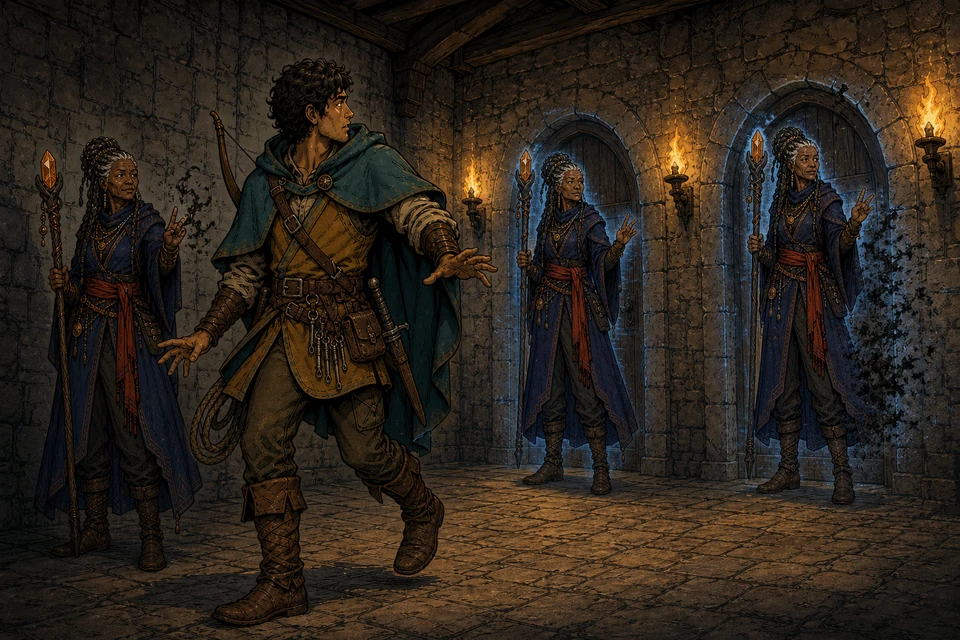
Use Conjure·Mind to create a perception of something absent, such as a phantom guard.
Use Alter·Mind to change or omit a perception of something present, such as making a real guard look different or imperceptible.
Who is fooled. Reach pays for each affected mind rather than the concealed or depicted subject, and each mind resists with Persistence. Untargeted observers, including those arriving later, perceive normally. Mindless creatures and devices are unaffected.
Keeping it going. A fixed illusion or sensory omission sustains a state without concentration. Actively directing its behaviour after casting is active control, and costs the Shaper’s Combat Action each round.
Seeing through it. A fooled witness can spend a Combat Action to oppose Perception against the stored Shaping result. Success identifies the falsehood, but neither Dispels it nor reveals concealed matter. After a failure, the witness needs new evidence to try again. Illusions cause no harm.
Physical alternatives. Physical Shaping can reach the same sensory benchmark where its cell permits: Bend·Fire can redirect light, Bend·Air/Storm can redirect sound, and Alter·Flesh can change natural appearance. These change a subject or the environment, not a mind, so use their actual targets, Reach, and defence instead of the illusion procedure. Created fog, smoke, and similar matter in the way use ordinary obscurity; they do not make a subject imperceptible.
All sixty cells
Forms run down the rows; cell names keep Technique·Form order.
Form
Conjure
Bend
Unmake
Alter
Ward
Scry
Fire
Conjure·Fire
Bend·Fire
Unmake·Fire
Alter·Fire
Ward·Fire
Scry·Fire
Water/Ice
Conjure·Water/Ice
Bend·Water/Ice
Unmake·Water/Ice
Alter·Water/Ice
Ward·Water/Ice
Scry·Water/Ice
Air/Storm
Conjure·Air/Storm
Bend·Air/Storm
Unmake·Air/Storm
Alter·Air/Storm
Ward·Air/Storm
Scry·Air/Storm
Earth/Stone
Conjure·Earth/Stone
Bend·Earth/Stone
Unmake·Earth/Stone
Alter·Earth/Stone
Ward·Earth/Stone
Scry·Earth/Stone
Flesh
Conjure·Flesh
Bend·Flesh
Unmake·Flesh
Alter·Flesh
Ward·Flesh
Scry·Flesh
Mind
Conjure·Mind
Bend·Mind
Unmake·Mind
Alter·Mind
Ward·Mind
Scry·Mind
Force/Motion
Conjure·Force/Motion
Bend·Force/Motion
Unmake·Force/Motion
Alter·Force/Motion
Ward·Force/Motion
Scry·Force/Motion
Spirit
Conjure·Spirit
Bend·Spirit
Unmake·Spirit
Alter·Spirit
Ward·Spirit
Scry·Spirit
Paths
Conjure·Paths
Bend·Paths
Unmake·Paths
Alter·Paths
Ward·Paths
Scry·Paths
Fate
Conjure·Fate
Bend·Fate
Unmake·Fate
Alter·Fate
Ward·Fate
Scry·Fate
Effects
Fixed benchmarks for damage, healing, protection, movement, senses, conditions, restoration, information, control, transformation, and conjured or called beings.
Effects. Fixed benchmarks for damage, healing, protection, movement, senses, conditions, restoration, information, control, transformation, and conjured or called beings. Also known as magic damage, magical healing, magic wards, magic summons, standing orders, calling spirits, conjured beings, invisibility, sensory concealment, magical flight, magical senses, water breathing, magical blindness, magical sleep, magical conditions, magical restoration, temporary hit points, vitality reserve.
Use the lowest Intensity that covers each outcome. Details follow the table.
Outcome
Effect
Immediate damage
Unmake deals Intensity D6; never add Damage Modifier.
Healing
Alter·Flesh restores 1D4 HP per Intensity.
Armour or reduction
Ward grants AP of twice Intensity against one class of harm.
Barrier
AP = twice Intensity; total HP = 5 × Intensity; Reach sets footprint.
Vitality reserve
Absorb up to 3 × Intensity HP after other protection and before actual HP.
Skill modifier
+1B/-1P at Intensity 2; +2B/-2P at Intensity 4.
Sensory concealment
I2: -1P to detect through one sense; I3: imperceptible through one sense; I4: every sense the cell governs.
Sensory impairment
I2: -1P through one sense; I3: suppress one sense; I4: every sense the cell governs.
Brief hindrance
Intensity 1 can halve Movement through the subject’s next turn.
Restraint or forced movement
Intensity 2 restrains a human-sized subject or moves it up to 3 metres.
Movement mode
I2: climb, swim, or traverse a named surface; I3: flight; I4: pass through a named mundane substance.
Movement speed
I1: +3 m; I2: ×1.5; I3: ×2; I4: ×3, for one named movement mode.
Lost Combat Action
Intensity 3, once; immune until the target completes a later Combat Action.
Incapacitation
Intensity 4; no Actions or Reactions, with a retry or defined break condition.
Full bodily or mental control
Intensity 4 and active control.
Damage, armour, and wounds
Where its Form permits, Unmake deals Intensity D6.
Projected Harm follows the normal damage rules, including nonmagical AP.
Direct Harm ignores nonmagical worn, natural, and object AP. Direct Harm against creatures retains Ward AP and named resistances. Unattended objects retain magical protection only.
Later effects use normal armour: subsequent hazards, summons, falling objects, and mundane consequences use ordinary armour rules.
Damage happens once. A Shaping damage outcome resolves once. Duration cannot attach damage to a target, repeat it each round, add it to every weapon hit, or retaliate when the protected subject is attacked or harmed.
A Trigger can delay one already-targeted damage outcome until an allowed observable event, then fires once. If a weapon attack is the Trigger, resolve the Shaping separately: neither result adds to, replaces, or inherits the other’s damage, defence, armour, or Critical benefits.
Mind and Spirit. Mind deals no HP damage. Unmake·Spirit damage is Direct-only: the target opposes with Persistence, and Unmake·Spirit deals Intensity D6 PP to a souled target.
For Spirit damage, only magical Ward AP and named resistances apply.
A visible spectral bolt is cosmetic Tell, not a projectile. It causes no HP loss, Major Wound, or Bleeding.
At 0 PP, a living target falls unconscious, a Spirit is banished, and possession ends.
Soulless targets are invalid. Use selected targets and the Direct Range route.
Healing and death
Healing stops at maximum HP and removes Bleeding and Dying. A living subject restored above 0 HP can act on its next turn; Wounded remains.
Once per rest. Like mundane treatment, a subject benefits from only one HP-restoring Shaping before its next full rest. Enchanted items and Confluence outcomes count. An outcome that only removes Bleeding and Dying restores no HP and is never limited.
Wounded. Below Intensity 3, healing restores HP to a Wounded subject but does not end Wounded or unlock natural recovery. Intensity 3+ healing counts as Surgery and unlocks recovery; after treatment, Wounded ends once HP exceeds MWL.
Poison and disease. Curing poison or disease needs Intensity of at least Potency divided by 25, and Shaping must win against Potency. After a failure, that Shaper needs new treatment, discovery, a full rest, or another meaningful change to retry.
Other harm. Fatigue, deprivation, age, and unrelated conditions need separate outcomes.
No regeneration. Shaping cannot regenerate. It cannot distribute healing across later turns, restore HP repeatedly through Duration, or create a pool that heals future injuries. Use one immediate healing outcome instead. A creature’s explicitly listed Regeneration remains a profile ability, not a Shaping benchmark.
Returning the dead requires Intensity 5, permanent Duration, a mythic ritual, a willing soul within reach, and a lasting price. The subject returns at 1 HP and Wounded. Restoring a destroyed body is separate.
Vitality reserves
A vitality reserve is finite magical protection, not additional Hit Points. It begins with 3 × Intensity points.
How it absorbs damage. After resolving Parry, armour, resistance, and every other applicable damage reduction, subtract qualifying HP damage from the vitality reserve. Any excess damages actual HP. For that hit, only the damage that reaches actual HP is compared with MWL.
Limits. A reserve changes neither maximum HP nor MWL, and cannot be healed or replenished. It absorbs HP damage only—not PP damage, a paid HP cost or sacrifice, or another effect that causes HP loss without dealing damage. It absorbs only damage its declared method can protect against, and the cell must explain the protection: Alter·Flesh might impart supernatural vigour, Ward·Force/Motion a finite force shell.
Duration. A reserve persists across any number of damage instances until depleted or its Duration ends. Once depleted, the reserve ends even if its Duration remains. Unused points vanish when Duration ends without changing actual HP.
One at a time. A subject can have only one vitality reserve. When a new reserve is granted, compare it with the existing reserve’s remaining points and keep the larger; on a tie, the subject chooses. The discarded reserve ends. Only a new casting or a separately paid item activation can grant a fresh reserve, so a vitality-reserve enchantment must be Activated or Charged, never Continuous.
Ward AP remains repeatable against its defined class of harm; a vitality reserve instead provides a finite, depletable pool. Neither can retaliate with damage.
Corporeal undead
Alter·Flesh repairs corporeal undead at normal healing Intensity. It restores no soul, identity, intelligence, memory, or loyalty.
Unmake·Flesh damages living and corporeal undead bodies normally.
Conjure·Flesh can animate remains as a temporary generic Mindless, Soulless Undead summon. Use the conjured-being table without a Form trait or drawback. The remains collapse at 0 HP or when the Duration ends; conjured matter vanishes.
Lasting undead require a named profile, profile-based Intensity, Duration 5, a mythic price, and a vulnerable physical anchor. Intelligence grants no former identity, memories, or loyalty.
Alter·Flesh at Intensity 5 and Duration 5 can make a living subject Undead through a mythic ritual and lasting price. Its soul departs.
Undead made or sustained by Shaping are active magic, anchored vulnerably to a body or remains. Existing undead are not inherently Shapings.
Modifiers and transformation
A modifier names one skill or narrow family of skills; identical magical modifiers do not stack.
A transformation changes appearance and form. AP, attacks, movement modes, senses, Size benefits, and other mechanics need additional outcomes, guided by an existing profile. Concept grants permission, not capabilities.
Movement, senses, and adaptation
The benchmark prices a capability, not its fictional method. The chosen Technique·Form must explain how it works, and determines valid subjects, defence, and side effects. Alter·Flesh might grow adhesive pads, Bend·Force/Motion might hold someone against a wall, and Earth cells might reshape or create handholds. None can perform the others’ method merely because the movement result is similar.
Movement
Intensity
Capability
2
Gain a climb or swim mode at normal Movement, or traverse one named surface such as water or walls at normal Movement.
3
Gain flight at normal Movement.
4
Pass through one named mundane substance at half Movement; end every Movement Action in empty space.
Speed. Instead of gaining a capability, a separate speed outcome can increase one named movement mode by 3 metres at Intensity 1, multiply it by 1.5 at Intensity 2, double it at Intensity 3, or triple it at Intensity 4. Use only the strongest magical speed adjustment to that mode. Work out its magical speed first, then apply mundane reductions such as Fatigue, darkness, or encumbrance.
Who moves. A granted mode is subject-directed: its user spends their own Movement Action and chooses where to move. Sustaining it needs Duration, but neither concentration nor the Shaper’s Combat Action.
If the Shaper instead directs another subject’s movement, that is active control:
The Shaper spends their Combat Action each round, and the subject moves on its turn using its own Movement Action.
An unwilling subject under active control moves at most 3 metres per round, in any direction. It can retry its defence as for any ongoing hostile condition.
When a mode ends, unsupported subjects fall, and other impossible movement stops where the fiction permits.
Limits. A movement capability grants permission and the listed speed, not automatic success in dangerous conditions. Athletics may still be required for violent currents, unstable surfaces, tight passages, or similar hazards. Passing through matter grants no protection, perception, or ability to remain inside it. If the subject cannot leave the substance within the same Movement Action, it returns to the point where it entered.
Senses
Intensity
Capability
1
Low-Light Sight or an equally narrow improvement to an existing sense.
2
Night Vision, or a narrow environmental sense that reveals specified information but does not replace sight.
3
Blind Sight through one named sense, with a declared blocker; it can substitute for sight only where that sense supplies the necessary information.
4
A broad supernatural sense that can detect and locate one defined class its Form governs, limited by purchased Range and a declared blocker.
These benchmarks grant a usable sense. A single clue, diagnosis, location, or observation uses the Scry benchmark instead.
A sense provides only information its method can logically perceive. Use Perception whenever noticing something remains uncertain.
Apply only the best relevant sense; senses do not stack.
If one Shaping directly conceals the evidence from a magical sense, oppose their original Shaping results rather than treating either as automatic.
Breathing
Intensity
Capability
1
Hold breath for up to 10 minutes.
2
Breathe one named medium, such as air or water.
3
Function without breathing while the effect lasts.
Breathing water does not grant swimming, and functioning without breath does not grant protection from pressure, heat, cold, corrosion, obscurity, or contact hazards. It prevents suffocation and effects whose only route is inhalation. Hazards that also burn, poison through contact, or otherwise cause harm still require their own protection.
Sensory concealment
Sensory concealment hides a subject. Choose what is concealed, which senses it affects, and whether it changes the perceivers or the physical world.
At Intensity 2, Perception tests using one named sense to detect the subject take -1P.
At Intensity 3, the subject is imperceptible through one named sense.
At Intensity 4, it is imperceptible through every sense the cell can govern.
Intensity never widens a Form’s scope.
Reach, targeting, and defence follow what the Shaping directly affects: perceiving minds for an illusion, or the concealed subjects or area for a physical change. Concealment removes direct sensory evidence only; footprints, opened doors, displaced matter, and other physical consequences remain.
Invisible to sight. When Intensity 3+ removes sight, apply the Pitch black vision and attack consequences only against the concealed subject: vision-based Perception and ranged attacks cannot succeed without another applicable sense, and Close attacks take -3P. The observer’s surrounding illumination and Movement are unchanged.
Sensory impairment
Sensory impairment is a condition on a perceiver; sensory concealment instead hides a particular subject or evidence. Reach for impairment counts affected perceivers. A bodily change normally faces Resilience, while a change to perception normally faces Persistence.
At Intensity 2, tests relying on one named sense suffer -1P.
At Intensity 3, suppress that sense completely.
At Intensity 4, suppress every sense the cell can govern.
Intensity never widens a Form’s scope.
Blinded. Suppressing sight applies the Pitch black consequences generally to the impaired subject: vision-based Perception and ranged attacks cannot succeed, Close attacks suffer -3P, and Movement is quartered, unless another applicable sense supplies what sight would. Other suppressed senses lose only information and functions that logically require them.
No double penalty. Use only the strongest applicable sensory limitation. Impairment and concealment do not add their penalties together. An alternate sense perceives normally when its method can detect the evidence: optical invisibility does not hide body heat from heat-based Blind Sight.
Conditions and restoration
A condition name describes paid consequences. It does not grant a free package of damage, movement, control, transformation, or other effects. Choose the lowest benchmark covering the exact result, and use the declared Technique·Form to explain its method.
Intensity
Condition benchmark
1
Knock a human-sized subject prone, or impose a brief hindrance such as halved Movement through its next turn.
2
Restrain a human-sized subject, partially impair one sense, or impose the standard -1P modifier on one skill or narrow family.
3
Suppress one named sense, remove one Combat Action once, or impose a serious tactical compulsion as limited by the control rules.
4
Incapacitate through a declared state such as magical sleep or paralysis: no Actions or Reactions while it lasts, subject to a retry or an immediate defined break condition.
Duration sustains a state but never repeats a one-use outcome. In particular, a lost Combat Action occurs once regardless of Duration, and that target remains immune until it completes a later Combat Action.
Conditions of the same kind do not stack; use the strongest. Incapacitation alone means no Actions or Reactions, not automatic damage, movement, control, or helplessness. If a declared condition necessarily adds helplessness or another consequence, include it when judging the Intensity, and give it an appropriate retry or break condition.
Escaping a condition
Unless a rule below or the condition itself gives an easier escape, a subject under an ongoing hostile condition can spend a Combat Action to retry its original defence against the stored Shaping result.
If the condition prevents Combat Actions, the subject can retry freely at the end of the affected subject’s own turn instead. Resolve that turn’s restrictions before rolling.
Winning frees that subject but does not restore any Actions it missed. Failure leaves the condition in place.
Influence and full control use their own escape rules.
A declared break condition can replace the retry. For example, magical sleep can make its subject unconscious and helpless, but end immediately upon damage or when an adjacent character spends a Combat Action to wake it.
Removing conditions
Identify the source before choosing a restorative Shaping:
Active magic: only Dispel ends the Shaping. Another condition-removal outcome cannot cheaply cancel or suppress it while its source remains active.
Poison or disease: use the Potency-based curing rule under Healing and death.
Bleeding, Dying, or Wounded: use their specific healing rules. Restoration does not bypass Wounded’s Surgery and HP requirements.
Fatigue: Intensity 3 removes Fatigued or reduces Exhausted to Fatigued; Intensity 4 removes Exhausted entirely. It does not remove deprivation or another continuing cause.
Another nonmagical condition: use at least the Intensity that could impose the same mechanical severity, with a cell that can genuinely reverse its cause. Restoring a suppressed mundane sense, for example, is Intensity 3.
Removing a condition does not restore HP, senses, or other losses unless those are included as paid outcomes. If exposure, restraint, deprivation, or another cause remains, the condition can return normally.
“Curse” is not a separate mechanical category. Record its exact effects and source: Dispel an active magical curse, reverse a completed permanent change with a new appropriate Shaping, and resolve an oath, debt, quest, or mythic price through its own terms rather than generic condition removal.
Restraint, influence, and control
Intensity
Influence and control
1
Colour an emotion or plant a plausible suggestion.
2
Compel one limited, reasonable action. It cannot spend or deny a combat Action, cause immediate tactical disadvantage, or oppose the subject’s interests.
3
Compel an action that spends or denies a combat Action, causes immediate tactical disadvantage, or opposes the subject’s interests; or remove one Combat Action.
4
Full control.
A compelled combat act occurs on the subject’s next turn, spending its Action and granting no extra one.
A restrained subject can spend a Combat Action to retry its original defence against the stored result.
Full control grants another Persistence defence against the stored Shaping result before serious self-harm, defining betrayal, or a central belief’s violation; winning frees that subject, and certain death always grants one.
Directing control. Directing active control spends the Shaper’s Combat Action. The subject obeys on its own turn, spends the corresponding Action, and gains none. Without maintenance it regains control, and magical movement stops where the fiction permits.
Wards and barriers
A Ward grants one benefit:
AP or reduction equal to twice Intensity against one class of harm;
+1B at Intensity 2, or +2B at Intensity 4, to one defence; or
denial, priced as restraint, with each crossing opposing the appropriate defence against the stored Shaping result.
Classes of harm
Physical: blows, missiles, falls, and crushing.
Elemental: fire and heat, cold, lightning, and acid.
Spiritual: PP damage; only Ward·Spirit protects against it.
A class covers its harm whether mundane or Shaped, so an elemental Ward stops a burning building and an Unmake·Fire bolt alike. Covering both physical and elemental harm raises the Ward’s Intensity by 1, and its cell must explain both.
The cell must explain the hardening. Ward·Earth/Stone might turn skin to stone against blows or bake it to clay against heat, and Ward·Air/Storm might whirl aside missiles or insulate against heat, cold, and lightning. Ward·Fire protects only against elemental harm, and Ward·Force/Motion only against physical harm.
Mind, Paths, and Fate grant no AP:
Ward·Mind: a defence bonus to Persistence against Mind effects, or denial of one mental intrusion such as illusion or control.
Ward·Paths: denial at a threshold, barring passage across it or arrival there by Paths.
Ward·Fate: a defence bonus against a named doom, declared as Fate requires.
Ward AP and worn armour. Ward AP never adds to worn armour against one damage source: use the higher, or Ward AP alone when worn armour cannot protect. Same-kind magical protection never stacks.
Barriers. A solid barrier blocks movement and line of effect until destroyed, and cannot appear through occupied space. Trapping an unwilling subject is hostile restraint: the defender chooses Dodge or Resilience. Forms unable to make solid structures cannot use barrier statistics.
Scry
Intensity
Information within purchased Range
1
Detect a defined presence or reveal one immediate clue.
2
Locate, diagnose, communicate, or see through ordinary concealment.
3
Observe a distant scene, read surface thoughts, or reveal deeply hidden information.
4
Reach guarded memory, obscured history, motives, or uncertain possible futures.
Scry gives evidence, not omniscience or knowledge absent from accessible minds, places, spirits, traces, or patterns. Possible futures change when acted upon. Live observation, communication, or thought-reading needs concentration; static senses and facts do not.
Summons and called beings
Conjure creates a temporary being from its Form. Calling brings an existing being that belongs to a Form. Both serve under standing orders.
A Shaper can have only one combat-capable summon, created or called, or one actively controlled subject. Reach cannot bypass this.
Standing orders
When casting, give the summon one short standing order, such as “guard me”, “attack the ogre”, or “hold this door”.
It acts on its own turn immediately after its Shaper, spending its own Combat Action, Movement Action, and base Reaction to carry out that order. This includes Opportunity Attacks when ordered to guard or attack.
A Mindless summon follows its order literally; one with a mind uses judgement.
Changing the order costs the Shaper’s Movement Action, once per round, within 15 metres and line of effect. Out of that range, or while its Shaper is unconscious, a summon keeps its last order.
A summon needs Duration but neither concentration nor the Shaper’s Combat Action, so damage to the Shaper does not end it.
It ends at 0 HP, at Duration’s end, on dismissal, or through Dispel.
Conjured beings
Intensity
HP
AP
Attack/defence
Damage
Strike Size
SIZ
1
3
0
25%
1D3
Light
3
2
6
1
40%
1D6
Medium
9
3
10
2
55%
1D8
Medium
13
4
14
3
70%
2D6
Heavy
18
A conjured being has Movement 15, PP 0, and no Damage Modifier.
The listed attack covers its natural attacks. The listed defence covers Dodge, Resilience, Persistence, Perception, and physical Parry.
It ignores Major Wounds and vanishes at 0 HP.
Reach 0 makes it human-sized or smaller. Reach 1 makes it mount-sized: +50% HP, Movement 20, strike Size one step larger, and room for one rider.
Shaping never creates a soul, so every conjured being is Soulless. Its Form sets its body, tags, one signature trait, and one drawback at no cost:
Form
Being
Tags
Signature trait
Drawback
Fire
Flame being
Elemental
Immune to fire; sheds torchlight; its strikes ignite exposed mundane fuel
Dousing or a hit from Water/Ice Shaping deals +1D6; cannot enter deep water
Water/Ice
Water or ice being
Elemental
Swims at normal Movement; immune to cold and drowning
Movement 10 on land
Air/Storm
Wind being
Elemental
Flies at normal Movement at Intensity 3+, otherwise hovers; immune to falling
AP 0 at every Intensity; cannot carry, grapple, or block a passage
Earth/Stone
Stone being
Elemental
+2 AP
Movement 10; cannot swim, fly, or climb
Flesh
Beast
Living, Corporeal, Soulless; an animal mind
Low-Light Sight and scent; Alter·Flesh heals it
Subject to Mind, poison, disease, and Bleeding
Force/Motion
Force construct
Construct: Mindless, Soulless
Lifts and carries as STR 18; immune to poison and disease
Perceives only by touch and where its Shaper directs it
Spirit, Paths, and Fate create no beings: Spirit and Paths call existing ones. Conjure·Flesh can instead animate remains as Mindless, Soulless Undead; see Corporeal undead.
More capable beings. Capabilities beyond the table and Form raise its minimum Intensity or add an outcome under their own benchmarks. These include flight for a being of another Form, invisibility, extra natural armour, special senses, and spellcasting.
Giving a Mindless being a mind, so that it understands complex orders, speaks, and becomes a valid Mind subject, raises its Intensity by 1.
Removing its Form’s drawback also raises its Intensity by 1.
A conjured being cannot be Incorporeal.
Calling beings
Only beings that belong to a Form, or to which the Shaper holds a genuine link, can be called. Ordinary creatures—beasts, monsters, and people—cannot. Instead, move one already within Range with Bend·Paths, sway it with Bend·Mind, or conjure a being.
Callable being
Cell
Range
A Spirit
Conjure·Spirit
Arrival point
An Elemental
Conjure·Fire (Salamander or Shade), ·Water/Ice, ·Air/Storm, or ·Earth/Stone
Arrival point
An otherworldly servant of a power the Shaper is pledged to, such as a Holy Steed or Holy Warrior
Conjure·Paths
4 through that link; otherwise 5
A specific individual linked to the Shaper by true name, token, or blood bond
Conjure·Paths
Must also reach its location, usually 4
An Anchored being cannot be called beyond its anchor’s boundary.
Intensity. Intensity equals the being’s Threat Intensity and cannot exceed maximum Intensity. For the bestiary: Small Elemental 2; Ancestor Spirit and Ghost 3; Medium Elemental, Disease, Healing, Magic, and Passion Spirits, and Holy Steed 4; Large and Huge Elementals and Holy Warrior 5.
Resisting. An unwilling being opposes calling with its Persistence or 20 × Threat Intensity%, whichever is higher. A being that comes willingly, through a pact or bargain, makes no roll.
Shaping wins: it arrives bound for the Duration and serves under standing orders as a conjured being does, using its own profile. At Duration’s end, a Spirit or Elemental returns to its Form; a specific individual remains where it is, unbound, and remembers its treatment.
The being wins: it does not come; the casting still pays its full cost.
Fumble: instead of Backlash, the Gamemaster can have it arrive free and hostile.
A called being with Shaping casts with its own PP and cells, but its ongoing Shapings count against its caller’s Active Magnitude.
Created, summoned, transformed, or compelled beings cannot summon, contribute PP, create magical resources, or pay ritual prices.
Ongoing Shapings and Magical Actions
All your ongoing Shapings together cannot exceed your INT. Sense Magic and Dispel need no known cell.
Ongoing Shapings and Magical Actions. All your ongoing Shapings together cannot exceed your INT. Sense Magic and Dispel need no known cell. Also known as active magic, Active Magnitude, concentration, Sense Magic, Dispel magic.
Ongoing Shapings
Your Active Magnitude is the total Magnitude of all your ongoing Shapings. Active Magnitude cannot exceed permanent, unmodified INT.
INT represents the complexity a Shaper can keep organised, while POW supplies the PP that fuel and commit magic. A temporary change to INT does not affect this limit; a permanent change recalculates it.
What counts. Every ongoing Shaping counts its full Magnitude. This includes concentration, modifiers, Wards, barriers, summons, control, movement modes, senses, concealment, conditions, vitality reserves, waiting Triggers, and tied anchors. Enchantments moved into Enchantment Capacity are the only exception. A called being’s own ongoing Shapings also count against its caller’s total.
Instant effects and completed permanent transformations are no longer ongoing and count nothing. You can dismiss an ongoing Shaping on your turn without an Action.
Keeping it going
Passive: a passive ongoing benefit, including a subject-directed movement mode or fixed sense, needs Duration but no maintenance Action.
Summons: a summon follows its standing order without maintenance; changing it costs the Shaper’s Movement Action within 15 metres and line of effect.
Concentration and active control: each costs your Combat Action every round. You can maintain only one at a time.
Check Range and route when a set Duration begins. After that, check them only during concentration or active control: the subject must stay within Range and a valid route, unless Range 4+, Indirect, or the Form creates another link. Damage or serious distraction to the Shaper forces a Persistence test; failure ends maintenance. Record each ongoing Shaping’s Magnitude and casting result.
Indefinite Shapings
An indefinite Shaping, or a permanent anchored enchantment made without Enchanter, commits full Magnitude from current and available maximum PP, even on a Critical.
Your reduced maximum governs recovery while it lasts.
Leave at least 1 available maximum PP, unless helplessness until an outside Dispel is a declared mythic price.
When it ends, your maximum returns; current PP recover normally.
Others cannot pay this commitment.
Temporary matter
Temporary matter vanishes at Duration’s end. It leaves no value, permanent crafting supply, PP, IP, Hero Points, Talents, components, anchors, or prices. Complex objects still require relevant Craft, Mechanisms, or Lore.
Created hazards
Created matter or phenomena can provide paid terrain, obscurity, barriers, restraint, or other non-damaging effects, but never automatic Shaping damage each round.
A harmful creation cannot appear overlapping an unwilling subject. Damage at its creation is one separately paid immediate Unmake outcome.
Fire ignited in mundane fuel, a collapsing mundane structure, and other genuinely changed environmental hazards thereafter use the core rules rather than recurring magical damage.
Universal magical actions
These actions use your Practice and Tell but require no cell.
Sense Magic
Spend a Combat Action and 1 PP, and test Shaping to sense active magic within 15 metres.
Success reveals its location and Form.
Critical also reveals its Technique, its Magnitude, and whether it is concentrated, triggered, or anchored.
Failure reveals nothing.
Fumble gives a false impression and a conspicuous Tell, not Backlash.
Veiled magic opposes your test with its original result.
Dispel
Spend a Combat Action to end one active Shaping.
Price it. Dispel Magnitude equals the target’s full Magnitude plus Range. Reach is 0 for one Shaping, regardless of its area.
Cast it. Test Shaping and pay normally.
Beat the original. On a Success or Critical, roll a Shaping check for the original Shaper, against their current unmodified Shaping, and oppose your result with it. If their skill is unknown, use 10 × original Magnitude, maximum 100%. The dispeller must succeed and win.
Completed permanent transformations cannot be Dispelled; active anchored enchantments can.
Rituals and Examples
Rituals reach higher Magnitudes through time, preparation, pledged PP, and lasting mythic prices. Examples show complete builds.
Rituals and Examples. Rituals reach higher Magnitudes through time, preparation, pledged PP, and lasting mythic prices. Examples show complete builds. Also known as magic rituals, mythic Shaping, Shaping examples.
Rituals
A ritual is a slow, prepared casting.
When you need one. Rituals are required above Safe + 2, and for any outcome at Intensity 5, Range 4+, Reach 3+, or Duration 3+.
What it takes. Each ritual takes one hour per Magnitude, a prepared place, full Practice, and a fitting focus or offering.
What it gives. A ritual grants +1B and permits Safe Magnitude + 2 or 2 × Safe Magnitude, whichever is greater. Going beyond that requires a unique campaign event, exceptional preparation, Gamemaster approval, and a serious lasting price.
The ritual test. Start from this base modifier:
Magnitude compared with Safe
Base modifier
No greater
None
1–2 higher
-1P
3+ higher
-2P
Then apply the ritual’s +1B, normal Assistance, circumstances, and the dice cap. Failure above Safe is overreach.
Helpers and pledged PP
Willing participants who stay and join the Practice can pledge PP. Pledges cover the full Magnitude, and the leader pledges at least 1 PP.
Draw the first PP from the leader, then follow the declared order. A Critical leaves unused pledges unspent.
One capable Shaper can Assist. Only the leader rolls and suffers Backlash.
On a fumble, every contributor advances one Fatigue step (normal → Fatigued → Exhausted). An Exhausted contributor falls unconscious for 3D6 minutes and awakens Fatigued.
For an indefinite ritual, the leader personally commits full Magnitude, and nobody contributes PP. A permanent anchored enchantment made without Enchanter uses the same personal commitment.
Permanent and Mythic Shapings
Permanent results. Permanent mundane creation requires equivalent material. It, and completed permanent transformations, become real and inactive; reversing them needs a new Shaping.
Enchantments. Supernatural properties remain active enchantments. Each has a vulnerable physical or spiritual anchor through which it is Dispellable.
Without Enchanter, its full Magnitude commits the creator’s maximum PP and counts against their active total, whether it uses Duration 4 or Duration 5.
With Enchanter, that Magnitude counts against Enchantment Capacity instead, not PP commitment or the active total. See Enchanted Items.
Mythic rituals. Any dial at 5 makes a ritual Mythic. It requires a declared lasting price: permanent POW, a unique treasure, a binding oath, a supernatural debt, a permanent change, or a consequential quest.
The price pays for crossing a mythic boundary; it never reduces Magnitude, PP commitment, active total, Enchantment Capacity, or Dispel strength.
Consume materials when the ritual begins. Permanent POW, oaths, debts, quests, and other changes attach after success resolves. A fumble exacts them only if announced beforehand.
PP alone cannot restore the dead or rewrite the setting, and rituals cannot create their own costs.
Examples
Builds abbreviate Intensity as I, Range as R, Duration as D, and Magnitude as M.
Intent
Build
M
Result
2D6 firebolt within 15 m
Unmake·Fire; I2, R1
3
Projected: Dodge or shield Active Guard; Medium Impact; AP applies.
2D6 ice shard within 15 m
Unmake·Water/Ice; I2, R1
3
Projected; resolves exactly like the firebolt.
2D6 frost burst, 3 m radius at 15 m
Unmake·Water/Ice; I2, R1, Reach1
4
Aware subjects, including allies, may Dodge at -1P.
2D6 searing heat within 15 m
Unmake·Fire; I2, R1, Direct
4
Resilience opposes; ignore nonmagical AP.
2D6 flesh wither within 15 m
Unmake·Flesh; I2, R1, Direct
4
Resilience opposes, exactly as for searing heat.
2D6 PP soul assault within 15 m
Unmake·Spirit; I2, R1, Direct
4
Persistence opposes; a Soulless target is invalid.
Scene-long 3 m stone wall
Conjure·Earth; I2, D1, Reach1
4
AP 4, 10 HP total.
Teleport a willing subject within 15 m
Bend·Paths; I2, R1
3
Range reaches both subject and safe destination.
Scene-long one-way portal within 15 m
Conjure·Paths; I3, R1, D1
5
Stationary; each traveller spends a Movement Action.
Treat a Major Wound by touch
Alter·Flesh; I3
3
Restore 3D4 HP, remove Bleeding/Dying; counts as Surgery.
6 AP stoneskin for a scene
Ward·Earth; I3, D1
4
Physical harm only; use it or worn armour, whichever is higher.
Scene-long supernatural vigour
Alter·Flesh; I2, D1
3
Gain a 6-point vitality reserve; maximum HP and MWL do not change.
Scene-long finite force shell
Ward·Force/Motion; I3, D1
4
Gain a 9-point vitality reserve; it does not refill when depleted.
Grow scene-long adhesive climbing pads
Alter·Flesh; I2, D1
3
Climb at normal Movement; dangerous conditions may require Athletics.
Grow water-breathing gills until rest
Alter·Flesh; I2, D2
4
Breathe water; swimming speed is unchanged.
Fly under the subject’s own direction
Bend·Force/Motion; I3, D1
4
Scene-long; the subject uses its Movement Action and may still fight.
Direct another subject’s magical flight
Bend·Force/Motion; I3, D1
4
Active control costs the Shaper’s Combat Action each round.
Gain scene-long heat Blind Sight
Scry·Fire; I3, D1
4
Heat must be perceptible; barriers and insulation block it.
Optically hide a willing subject
Bend·Fire; I3, D1
4
Scene-long; sight and optical devices only; physical traces remain.
Blind a touched subject for a scene
Alter·Flesh; I3, D1
4
Resilience; sight is suppressed against everything until escape.
Put a touched mind into magical sleep
Alter·Mind; I4, D1
5
Persistence; unconscious and helpless until damaged or awakened.
Paralyse a touched living subject
Alter·Flesh; I4, D1
5
Resilience; no Actions or Reactions. Retry freely at the end of the subject’s own turn; missed Actions are not restored.
Restore a mundane suppressed sense
Alter·Flesh; I3
3
Repairs a bodily cause; ending active magical blindness needs Dispel.
Remove Fatigued from a touched subject
Alter·Flesh; I3
3
Removes Fatigued, but not deprivation or another continuing cause.
Burn a named ogre after the next hit
Unmake·Fire; I2, R1, Direct, Trigger, wait D1
6
Choose the ogre when casting; after the hit, it resists the separate 2D6 Direct Harm with Resilience.
Resilience opposes; heal yourself 2D4, capped by actual HP damage dealt.
Bless the next named test this scene
Bend·Fate; I2, Trigger, wait D1
4
Declare the trigger first; the test gains +1B.
1D4 healing potion
Alter·Flesh; I1, one-use binding
2
Two-hour ritual; keeps until drunk, then restores 1D4 HP.
Animate a corpse for a scene
Conjure·Flesh; I3, D1
4
Generic 10 HP Mindless, Soulless Undead; remains collapse afterward.
Stone guardian for a scene
Conjure·Earth/Stone; I3, D1
4
10 HP, AP 4, Movement 10; follows a standing order; change it with your Movement Action.
Call a Magic Spirit for a scene
Conjure·Spirit; I4, D1
5
Unwilling, it resists at 80%; if called, it serves bound under standing orders.
Hide one subject from five minds
Alter·Mind; I3, R1, D1, Reach2
7
Each resists Persistence; later observers remain unaffected.
Permanently return a willing soul
Alter·Spirit; I5, D5
10
Master mythic ritual, lasting price; restore a body separately.
Reading the examples at Shaping 50%. Safe Magnitude and maximum Intensity are 2. Magnitude 3 is one-step overreach at -1P; Magnitude 4 is two-step overreach at -2P. Greater Magnitude exceeds the Apprentice ritual maximum of 4 and requires a unique campaign event.