
When the bells rang backward
The Crownless Realms count their present age from a bell rung the wrong way.
Ninety-three years ago, Emperor Caldras IV entered the Hall of Measures to be crowned and never came out. The ministers beyond the bronze doors heard the coronation bells ring once, backward. When they forced their way inside, the throne was empty, the imperial crown was ash, and every mirror showed a different claimant.
By winter, the empire had come apart by writ, siege, unpaid garrison, marriage, and quiet theft. Three noble houses still claim the vanished throne, though none can master the others. Free cities guard charters bought from rival claimants. Elven, dwarven, goblin, orc, lizardfolk, merfolk, and pixie powers meet their neighbours as states, not curiosities. Beneath the Seven Lamps, temples preach civic duty while philosophers argue over whether any god has ever answered at all.
The empire is gone, but its bones remain. Crownroads cross the continent. Aqueducts feed cities that no longer obey Crownseat. Keeps and sea walls shelter people whose rulers would sooner fight than share a table. The seven great enchanted Crownworks still perform fragments of their old purposes, and all seven are failing.
Spend time on the old roads and their decay reveals itself. A Crownroad splits. A ward-stone falls silent. A once-predictable gate opens onto the wrong place. Each failure is rare enough to frighten a village and common enough that surveyors and repair crews make their living from the ruins.
Magic belongs to the same half-broken inheritance. A village boundary stone may turn grave-cold near the walking dead, though no one nearby can mend it. A Shaper may calm one bend of a river, then lack the strength to work again before resting. People use prayers, diagrams, songs, bargains, and battlefield gestures without knowing that scholars consider them one art in different dress. Soldiers care less for theory than for the warning: copper on the tongue, a doubled shadow, glass ringing in an empty room, script burning in the air. When the Tell appears, they interrupt the Practice, take cover, counter it, or run.
The impossible is real here. It has not made food plentiful, roads safe, surgery clean, or officials honest. A serious wound still changes every plan; without a surgeon’s care, a badly hurt traveller will not simply knit back together overnight.
Law changes at every gate. A bridge toll, ferry seal, clan banner, or city charter can settle what a sword only worsens. Lawful power may belong to any of the realm’s peoples, and allegiance is not written on a person’s face. The Synod of Seven Lamps runs hospitals, courts, schools, and burial grounds across the realms, even as believers and sceptics argue over the source of its miracles.
This is why a chartered company can matter. It may cross a disputed border without starting a war, examine a Crownwork without admitting that any claimant owns it, or recover a missing anchor before a rival learns it is gone. An army arrives beneath one banner. A company can pass between them.
The shape of the realms
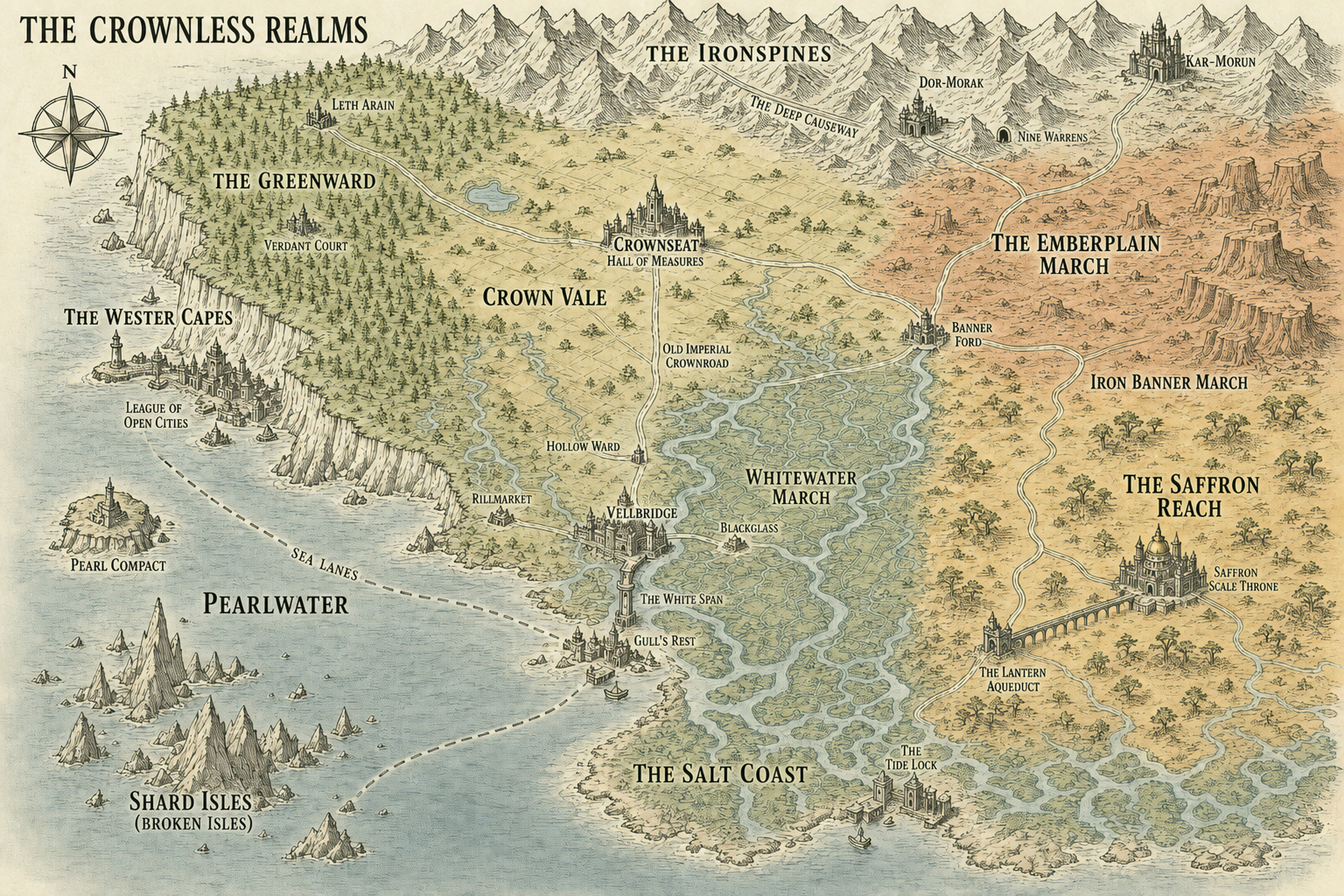
The known map covers the western two-thirds of the continent of Ordan and the neighbouring Pearlwater. Most travel is inland, across roads, farms, forests, uplands, and border marches; the rest runs along three long coasts and out among the Shard Isles.
The eight regions
Crown Vale
The old imperial heartland is a quilt of claimant estates, charter cities, temple holdings, and villages that still call themselves imperial because no one has told the tax rolls otherwise. Wheat and vineyards run up to abandoned signal towers. Crownseat, the former capital, is still the largest city in the west. Three governments hold different districts and each issues permits for the whole, while the empty Hall of Measures sits sealed behind three rival guard posts. This is the country of succession intrigue, forged writs, expeditions into inhabited ruins, and danger that wears livery. A company hired to escort one witness may find that every faction wants that witness alive for a different trial.
The Greenward
West of Crown Vale the forest swallows the old provincial line. The Verdant Court is an elven federation of grove-cities, human woodland cantons, dryad domains, and road abbeys. Its law divides the world into land that may be owned, land that may only be tended, and land old enough that it must be consulted. Outsiders dismiss this as mysticism, but change their minds when they see a dangerous bridge officially closed by the unanimous vote of its engineers, its villagers, and the naiad beneath it. The Greenward is neither timeless nor united: younger elves want the roads reopened, old houses remember imperial logging levies, and human charcoal towns fear the elven courts will erase their charters.
The Ironspines and Nine Warrens
The northern mountains hold the dwarven cities of the Deep-Road Compact and the goblin commonwealth called the Nine Warrens, their tunnels overlapping like two legal arguments. The dwarves keep the monumental roads, the ventilation towers, and the deep bridges. The goblin leagues hold the side galleries, the hot springs, the mushroom caverns, and most of the trade that actually keeps the miners fed. Dor-Morak, the Compact’s principal southern gate-hold, rises in terraces of caravan yards, embassies, lifts, and metal markets above clan vaults, foundries, and an elected engineering council. Visitors see a fortress cut into a mountain; the Moruni call it a treaty with the mountain, renewed every day. The Compact and the Warrens have been allies, rivals, and besiegers within living memory, and both now watch the old imperial Deep Causeway subside. Things sealed below it test every new crack, and the deep roads reward careful survey, a steady light, and the humility to turn back before a noise becomes a creature.
The Emberplain March
The eastern plains belong to the Iron Banner March, an orc-led confederation of clans, farm towns, veteran colonies, and mobile herding courts. The empire contracted the Banner to guard its frontier, then branded the same warriors as raiders whenever it failed to pay them. Banner courts still preserve the old service contracts alongside the warrants that contradicted them. Banner law is blunt, literate, and fixed on witnessed obligation. A guest may sleep safer under an orc roof than in a claimant’s palace, but an oath-breaker can be hunted across three realms. Wyverns nest in the red mesas, and the old battlefield dead climb out when weather uncovers an imperial mass grave.
The Saffron Reach
Beyond the eastern escarpment lie hot savanna, irrigated lowland, and salt desert under the Saffron Scale Throne. Its lizardfolk calendar-judges divide authority by season. Flood magistrates govern canals during the wet months, while dry magistrates govern roads during the dry months; neither office may command the other during the other’s season. Human and orc communities hold seats in the same courts, while caravan guilds exploit each seasonal transfer of authority to seek favorable routes, tolls, and permits. On the Reach’s western edge, Synod estates surround the Lantern Aqueduct, which carries protected water toward southern Crown Vale. Imperial maps call the Reach a conquered province; no surviving Scale record agrees. Its buried reservoirs, crocodile waterways, giant-lizard caravans, and sunken observatories draw treasure hunters, and heat, thirst, poison, and the wrong season’s warrant kill more reliably than any monster.
The Wester Capes
Cliff towns, fog islands, and wind-cut pasture run west of the Greenward. The League of Open Cities was born here when five ports bought their charters from three different claimants and dared any of them to admit the fraud. The League’s merchant councils defend free passage, private contract, and their own monopolies with equal conviction. This is a coast of smuggling coves, signal towers, shipyards, and old sea forts, with harpy nests and griffin aeries above the shipping lanes. League captains know a Pearl Compact navigator is worth more than another mast, but many resent the Compact’s new tolls and its claim of authority over routes their families sailed for generations as open water.
The Salt Coast
South of Crown Vale, broad estuaries and tidal marsh hold cities older than the empire. The Whitewater March—an established hub for chartered adventuring companies—occupies the lower river. Vellbridge stands inland, while the Crownroad runs south across the White Span to Gull’s Rest and the open sea. West of it, goblin salt factors and elven shipwrights share flood-prone wards. The Tide Lock, another Crownwork, guides currents along the entire Salt Coast and should divert the worst storm surges into the marshes before they reach its ports and lowland settlements. Lately it sounds its alarm at low tide and sometimes closes when the water is already high. Life here mixes court business with wet boots: missing cargo, failed levees, a murder at the customs house, wreck salvage, and a village with one night to make ready for a sea serpent.
Pearlwater and the Shard Isles
The Pearlwater is governed as much below the surface as above it. The merfolk Pearl Compact controls the reef passages, the tidal anchorages, the surface platforms, and the air-filled halls built into sea caves. Merfolk breathe air but can remain submerged for long stretches, so their settlements are engineered around breathing wells, sheltered chambers, and easy access to the surface. The Shard Isles beyond hold independent barons, temple refuges, pirate republics, and the shattered observatories of the imperial storm fleet. A fair wind carries a ship swiftly between the coasts; a storm can break it apart before a sword clears its scabbard.
Peoples, cultures, and languages
Upbringing, not blood, shapes culture and language. An elf fostered in Vellbridge may be a Whitewater marcher who speaks River Crown; a human raised among the groves at Leth Arain may belong to the Verdant Court and speak Ilyr. Humans are numerous but politically divided; the other peoples are long-settled citizens and powers, not curiosities.
| Origin | Peoples | Culture · language | Typical lives |
|---|---|---|---|
| Vale charterfolk | Mostly human; every people present | Crown Vale · Crown Speech | Clerks, retainers, artisans, tenant farmers, ruined gentry |
| Whitewater marchers | Human, goblin, dwarf, pixie | Whitewater · River Crown | Barge crews, wardens, smugglers, bridge engineers |
| Araini groves | Mostly elf and human | Verdant Court · Ilyr | Foresters, advocates, hunters, patient political heirs |
| Moruni holds | Mostly dwarf | Deep-Road Compact · Karic | Miners, masons, debt witnesses, surface factors |
| Ninefold commonwealth | Mostly goblin | Nine Warrens · Kesh | Couriers, machinists, hot-spring farmers, negotiators |
| Banner clans | Mostly orc; many human | Iron Banner · Varkesh | Riders, oath-keepers, veterans, travelling judges |
| Saffron courts | Mostly lizardfolk; human and orc minorities | Saffron Scale · Tessarak | Canal keepers, calendar lawyers, caravan guards, astronomers |
| Pearl houses | Mostly merfolk; mixed surface clients | Pearl Compact · Pelagic | Navigators, reef wardens, divers, treaty brokers |
| Thistledown relays | Mostly pixie | Thistledown Post · Briarlilt | Fliers, weather readers, cipher clerks, neutral messengers |
Religion under the Seven Lamps
Enter a Synod temple and you will usually find seven niches. Hearth keeps. Gate judges passage. Scale weighs. Rose binds love and grief. Hammer gives labour its dignity. Storm tests. Star guides the dead. A local temple may favour two or three Lamps, and their names and genders change as the road passes from one region to the next.
No god steps into the public square to settle the argument. No scripture accepted across the realms has a line that cannot be read three ways. Still, Synod hospitals work, and an oath at a Gate altar carries real social force. Some priests Shape through prayer with startling skill. Sceptics credit disciplined ritual; believers say discipline is how a mortal makes themselves heard.
Temple miracles are not effortless gifts. Priests must learn their sacred arts, draw upon their own strength, and accept that every working leaves signs others may recognize. Miracles can be opposed, and reaching beyond one’s abilities carries a price. The Synod’s greater achievement is practical: it trains healers, stocks their supplies, records who can treat grave wounds, and stations them along the roads that matter. Its worship shares the realms with ancestor rites, elven land-consultations, dwarven memorial guilds, Banner oath-fires, Saffron solar courts, and Pearlwater tide-vigils.
Shaping in daily life
Shaping is usually encountered as a sign before it is understood as an art. Surveyor Kelm taps three brass nails and feels the wound in a damaged road. Blue grit clings to a Moruni stone-reader’s hands, and every miner nearby stops hammering. A ferryman or miner may know the sign and the safe answer without knowing the theory taught by scholars who compare one tradition with another.
Most settled districts can name one Shaper. Their magic is small or narrowly specialised, and their strength runs out quickly. The practised are hired by name. The genuinely powerful attract courts. Masters belong to legend, to terrible old things, and to stories where a lasting price can redraw history.
Every tradition teaches recognizable rituals, though individual Shapers develop their own variations. Common examples include:
| Tradition | What its magic often looks like |
|---|---|
| Crown Survey | A measured course recited aloud while brass tools are aligned; nearby straight edges seem to double. |
| Synod service | A spoken litany with lamp, cord, or washing; the worker throws seven faint shadows. |
| Moruni stonecraft | A hammer rhythm and traced load-lines; dust settles into geometric ridges. |
| Araini husbandry | Breath, sung names, and a living focus held in the hands; leaves turn their pale undersides out. |
| Banner oathwork | Witness and consequence declared over iron; every voice nearby picks up a second beat. |
| Ninefold wayfinding | Knotted thread, quick notation, and counted corners; the corners of a room seem briefly nearer. |
Whatever the tradition, Shaping is never automatically covert: its Practice can be interrupted, and its Tell leaves recognizable signs even when the intended effect conceals something. Institutions guard their teaching because it is scarce and politically useful.
The Crownworks make the realms seem more magical than their living Shapers could sustain. Each permanent enchantment is tied to a physical or spiritual anchor that can be found and, through it, undone. Their makers paid prices that no surviving archive records cleanly. To mend one takes more than a workshop and glowing tools. It calls for an expedition, ritual, hard bargaining, and perhaps another lasting price.
The Whitewater March
Many new companies begin in the Whitewater March. By Crownless standards it is prosperous: grain barges run on schedule, the road watch is usually paid, and the three powers claiming the March disagree without, for now, laying siege to it. Vellbridge can provide trouble before the wax on a charter cools, whether the business is a guild feud, a burglary, a court day, or another failure on the nearby White Span.
Vellbridge
Vellbridge stands beside the Whitewater where the imperial Crownroad enters the March. South of the city, the road crosses the White Span, one of the seven Crownworks, before continuing to Gull’s Rest. The Span is a monumental bridge-causeway of broad pale stone, and travellers walking it from gate to gate count fewer steps than its surveyed length should require. It once stayed dry, lit, and structurally sound in any weather; now its lamps dim in sequence, the distance lurches by a few paces, and one parapet weeps salt water at noon.
Thirty thousand people live among tiled counting houses, crowded river wards, old barracks, shrines, mills, and the claimant manors up on Measure Hill. The elected March Council runs the markets and the drains. House Veyran appoints the road warden. The League of Open Cities holds the river customs contract. The Synod claims the chapel at the White Span’s north gate. None of them can move without the others calling it the first step of an annexation.
A few places worth knowing:
- The Brazen Mule, an outfitter near South Gate, sells weapons, armour, camp gear, trail supplies, and the hire of draft animals, and rarely wants for stock. Its proprietor, Hesta Coil, refuses to call credit charity but extends it to companies who bring their wounded hirelings home.
- The House of the Rose Lamp keeps clean beds, medical stores, trained healers, and a surgeon’s table. Its senior surgeon, Doctor Samel Ancor, is not a Shaper and is proud of it. Sister Irra Vale can provide surgical care through Shaping when she is on hand and has the strength to spend.
- Third Measure Hall is a shrunken Crown Survey office. It can open a path to Shaping, but only for a candidate who has worked a real survey, kept their head near an unstable anchor, and accepted the obligations of the training. It is not initiation for the asking.
- The Bent Copper is a respectable bathhouse with a reputation for knowing more about missing papers and private business than its attendants admit. Its goblin manager, “Aunt” Neris Skell, can arrange discreet introductions, but she sells neither secrets nor loyalty cheaply.
- Thistledown Station Seven holds the old western bell tower, where pixie relays fly sealed message tubes between weather shelters. The service is physical, tiring, and delayed by storms and predators; a few trained couriers can relocate across a short distance by Shaping, but there is no instant long-range post. Postmaster Pella Underleaf treats neutrality as sacred and unpaid postage as a personal insult.
- The Charter House registers small companies. A charter grants no immunity, but it names your legal partners, sets how salvage is shared, and lets an authority hire you without having to recognise a rival state’s soldiers.
Four satellite settlements
Rillmarket, west of Vellbridge, gathers grain, horses, and news behind a timber palisade that also encloses three inns and a weekly claimant court. Locals whisper that a disused drainage tunnel beneath the market leads toward an imperial storehouse omitted from every surviving official map.
Blackglass, east of the city, grew around a dark-stone quarry. Dwarven engineers inspect its dangerous faces and goblin crews work its best machinery. Cutting into the rock exposed an imperial acoustic conduit tied to the White Span’s anchor casing beneath the crossing, and all work is officially stopped.
Hollow Ward, north of Vellbridge, is a half-inhabited imperial fort. The March Watch holds the gate and Banner traders hold the caravan yard, and on moonless nights something opens the sealed infirmary from the inside.
Gull’s Rest, beyond the White Span at the river mouth, is the March’s seaport. Its tidal basin takes fishing boats, river barges, one-masted couriers, and the larger League ships. Pearl Compact navigators keep an air-filled treaty hall cut into the breakwater. A merfolk visitor can reach every room by flooded ramp and surface often, while landfolk come in through the upper door.