Chapter 08

GM Tools

Procedures for the situations that reach past a single character: treasure, sea voyages, battles, playable races, minor NPCs, and epic play.

Gamemasters carry more rules than players. These handle what happens above the scale of one character in one fight — a hoard worth looting, a crossing that turns into a storm, two armies meeting, or a whole cast of NPCs who each need a number.

Nothing here is required. Take the sections a campaign actually uses and leave the rest.

Plunder Rating

Each creature carries a Plunder Rating from 0 to 6 that sets how much treasure it is likely to hold when the story does not decide for you.

Fantasy Crux is not a game of killing things and taking their stuff, but creatures met on an adventure do own things. Normally the story decides what a creature carries. When it does not, roll on the table below.

Every creature profile lists a Plunder Rating. For creatures that gather in groups, raise it by one for a group of up to twenty, by two for up to a hundred, and by three beyond that. Group treasure is held somewhere defended and guarded, and only the leader has access to it.

Plunder table

Rating Treasure found
0 Not a hoarder. No treasure whatsoever.
1 Chance hoarder. Loose change, 1D6 CP. A remote 5% chance of one enchantment, used by accident or carried in complete ignorance.
2 Enough for a rainy day. 5D20 SP and 1D10 GP. If the creature has supernatural abilities, a POW% chance of 1D4 minor enchantments suited to its nature.
3 Hoards for a better future, and knows what its treasure is worth. 5D100 SP and 3D20 GP. If the creature has supernatural abilities, a POW × 2% chance of 1D4 minor enchantments.
4 Significant hoard, gathered for hoarding’s sake. 10D100 SP and 1D100 GP. A POW × 3% chance of 1D6 minor enchantments and a POW% chance of 1D4 major ones.
5 Treasure trove, the wealth of a minor lord. Grave goods of a dead noble worth some 1D6 thousand SP, with 1D6 minor enchantments and a POW × 3% chance of 1D6 major ones.
6 Wealth of kings. A dragon’s hoard beyond comprehension: 1D4 million SP, 2D10 minor enchantments, 1D8 major ones, and one unique item.

Enchantments

Roll the minor and major enchanted items from that rule, which also covers who may use one and how it is identified.

In a campaign without Shaping, ignore that column and roll coin alone.

Enchanted Items

A Shaping bound to an anchor becomes an item anyone can use; the bearer pays its Power Points, and Sense Magic and Scry reveal what it does.

An enchantment is a Shaping bound to a vulnerable anchor, either a physical object or a spiritual locus. It stays active and Dispellable through that anchor.

Making one

Build the Shaping normally, then bind it to the anchor during the ritual. There are two routes:

  • Everyday work uses Duration 4: an ordinary ritual and no mythic price. Without Enchanter, its Magnitude commits the maker’s maximum Power Points and counts toward their active total for as long as it lasts.
  • Legendary work uses Duration 5: a mythic ritual and its declared lasting price. Without Enchanter, that price may itself free the working from the maker’s active total.

With the Enchanter Talent, either route instead counts against the original creator’s Enchantment Capacity and occupies neither their PP commitment nor active total.

Shaping expertise caps what a maker can attempt, through the ordinary ritual maximum: Magnitude 6 for a Veteran, 8 for an Expert, 10 for a Master.

A minor enchantment is Magnitude 1–4 and one modest effect. A major one is Magnitude 5 or more, or carries any dial at 5.

Using one

Anyone may use an enchantment. Neither the Shaping skill nor a known cell is required, and the item shows its maker’s Tell whenever it works, so using one is conspicuous.

Kind How it runs Power Points
Continuous Active while worn or held Commits the bearer’s maximum PP equal to Magnitude; removing the item restores it
Triggered Fires on the condition set at its making The bearer pays PP equal to Magnitude each time it fires
Consumable Potions, scrolls, and charges; spent on use Paid by the maker, so the bearer pays nothing

Activating an item costs a Combat Action unless its trigger says otherwise. A bearer without the available Power Points cannot use it at all.

Identifying one

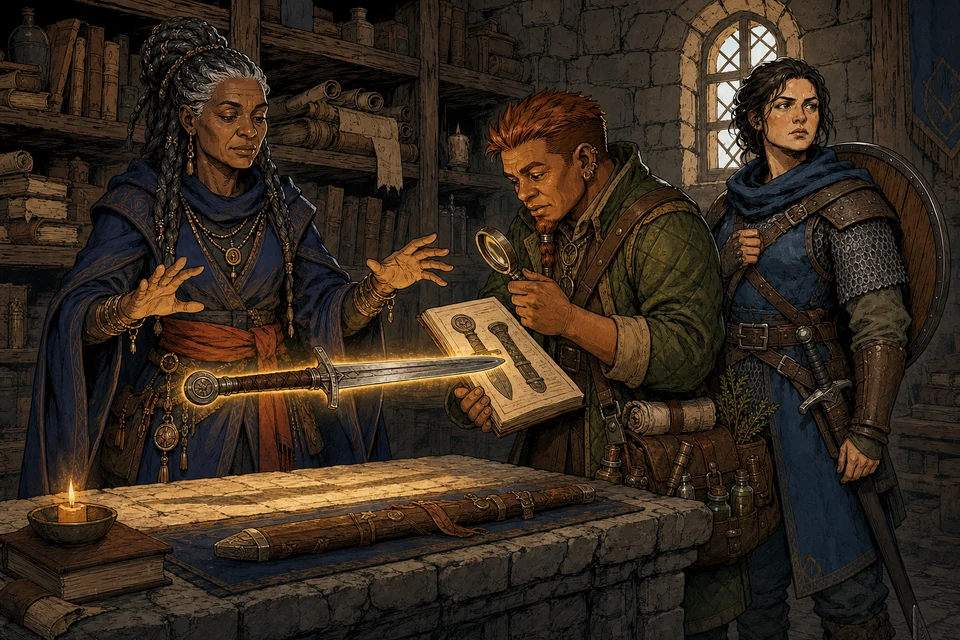
A mage and dwarf scholar examine a softly glowing old sword while a cautious warrior watches from a safe distance.

Sense Magic confirms that an item is magical and reveals its Form; a Critical adds Technique, Magnitude, and that it is anchored.

Scry the matching Form to learn more. Intensity 2 diagnoses what the item does and how to set it off; Intensity 3 reveals a curse, a limit, or a trigger its maker concealed.

Until then an item is only what it appears to be, and the Gamemaster may let use reveal the rest.

Destroying one

Break the anchor, or Dispel through it. A completed permanent transformation cannot be Dispelled, but an active anchored enchantment can.

Ships and Sailing

Ships are rated by crew, speed, structure, and cargo; the captain's Sailing skill drives travel, storms, and every naval manoeuvre.

Ship types

There are three broad classes of sailing ship: sloops, small and fast but fragile with one mast; brigs, fast and manoeuvrable with two; and ships proper, cargo vessels or warships with three masts or more.

Type of ship Crew Cost (SP) Manoeuvrability Speed Structure Cargo
One-masted 10 5,000 +1B 6 20 8 tons
Two-masted 20 15,000 5 40 15 tons
Three-masted 30 50,000 -1P 4 60 30 tons

Speed is in knots. Manoeuvrability applies to every Sailing test made aboard.

Ship weapons are abstract: many shots are loosed for each roll, so a vessel’s armament is a single percentage chance to hit. A hit deals 1D8 damage to the target’s structure points. Every 10% of weapons costs two tons of cargo and needs two more crew, and armament cannot exceed 100%.

Special features

Every ship has one special feature. A ship may carry more than one; each additional feature adds 50% of the original cost.

  • Armoured: 2 AP against every attack.
  • Fast: add one knot to speed.
  • Heavy weapons: hits deal 1D12 rather than 1D8.
  • High capacity: increase cargo by 40%.
  • Manoeuvrable: improve manoeuvrability by one step, to a maximum of +1B.
  • Marines: the ship can carry and quarter marines equal to its crew.
  • Ram: the ship rams without suffering damage in return.
  • Reduced crew: halve the crew needed to run the ship.

Sailing tests

Manoeuvres are governed by the captain’s Sailing skill, modified by the vessel’s manoeuvrability and by the crew’s average Sailing skill.

Average crew Sailing Modifier
25% or less, no idea -1P
26–50%, competent
51–75%, veteran +1B
76% or more, expert +2B

Travel and storms

A solitary stone watchtower stands above a stormy moonlit sea as rain sweeps across the cliff path.

In normal conditions a vessel covers 20 miles per day for each knot of speed. Listed speeds are averages. A strong favourable wind, perhaps magically arranged, can double them, as can a rowing crew whose Sailing test is a Critical. Becalmed with no wind at all, a ship does not move.

Each day out of sight of land carries a 5% chance of a storm. A storm deals 2D6 structure points. A ship at 0 structure points begins to sink, and one reduced past the negative of its original total sinks almost at once. Sailors on deck must Dodge to stay aboard; anyone swept overboard and not immediately recovered must make an Athletics test to survive.

The captain may make a Sailing test to halve a storm’s damage. Better still, a storm detected in time can be sailed around.

Naval combat

Ships hold one of two distances.

Contact. The vessels can see one another. If both want to close or both want to part, it happens automatically and takes about an hour. If they want different things, roll opposed Sailing tests.

Combat range. Combat runs as it does on land, except that Combat Order belongs to the ship rather than the crew: the faster vessel acts first. One test fires a ship’s weapons, and no defence is rolled against it. A character appointed weapons officer may make a Ranged Combat test; on a success the ship’s attack gains +1B.

Hand weapons are too small to trouble a hull, though they reach anyone on deck. Fire is the exception, and takes hold in sails and decking.

Manoeuvres

One manoeuvre per round, each requiring a Sailing test from the captain.

  • Broadside: on a success, fire the ship’s weapons twice instead of once.
  • Evade: on a success, the opponent cannot broadside, ram, or board. The vessel may also break to contact range if the other allows it or the opposed Sailing test succeeds.
  • Ram: on a successful opposed Sailing test, deal 1D6 damage per mast. A ship without a ram takes half that damage itself.
  • Board: on a successful opposed Sailing test the vessels are roped together and boarding begins. A successful ram grants an immediate free boarding attempt, and if both crews want to board it happens automatically.

Mass Combat

Resolve a battle with opposed Lore (Military Tactics) tests between commanders, then check whether the losing side routs.

Use these rules for a one-roll solution to a battle. The commanders’ skills decide it, modified by the armies they lead.

Resolving the battle

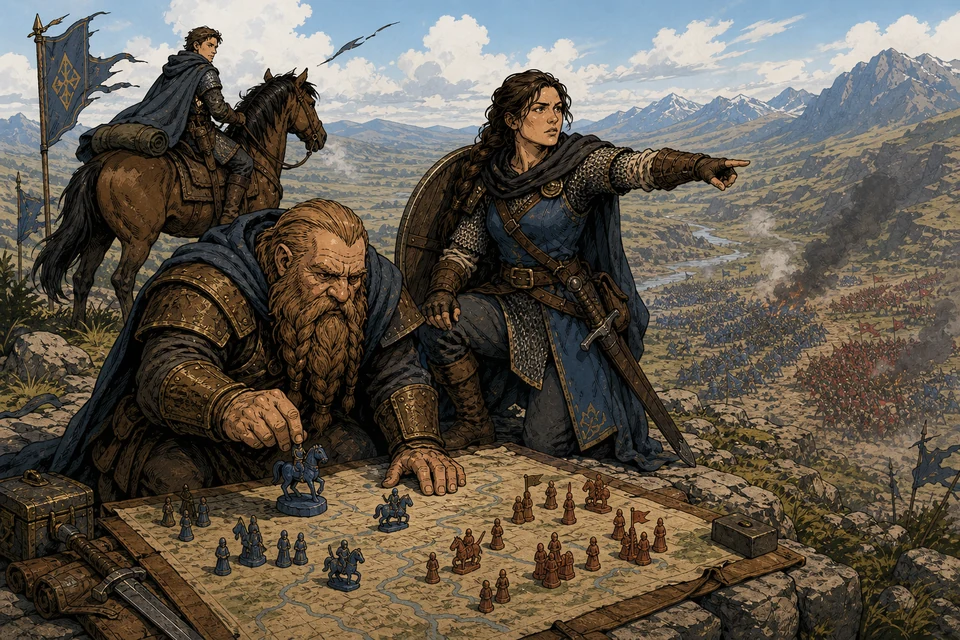
A dwarf commander moves army markers on a ridge map while a warrior points to a breach in the battle below.

The two commanders make an opposed Lore (Military Tactics) test. Each army whose commander succeeds inflicts casualties on the enemy equal to half its own numbers; a Critical doubles them. Half of any casualties are deaths and half are injuries. The commander who wins the opposed test carries the day; if both fail, the armies disengage after indecisive skirmishing.

Modify the test for the situation:

  • Better equipped than the enemy: +1B.
  • Better trained than the enemy: +1B.
  • Significant special forces the enemy lacks, such as artillery, cavalry, or war Shapers: +1B for each.
  • Outnumber the enemy two to one or more: +1B.
  • Outnumber the enemy four to one or more: +2B.
  • Enemy holds a defensive position: -1P.
  • Enemy holds fortifications: -2P.
  • Player character heroics, such as cutting down a key officer or seizing ground: +1B, or -1P if the attempt goes badly wrong.

Rout

The commander of the losing side must then make an Influence or Performance test. On a failure the army routs: troops flee in panic, or surrender when they cannot flee, and a further 10% of the army is lost. On a success the force withdraws in good order. Only on a Critical does a beaten force keep fighting. A force with nowhere to retreat to fights on regardless.

Larger forces may split into several armies, each with its own commander. Resolve each the same way; every army must choose an opposing force to attack.

Calling for Tests

Ask for a roll when the outcome is uncertain and the stakes are real, and resolve whole groups with a single test where one roll can stand for many.

The basic test says when a roll is possible. This section is about when it is worth making.

When to test

Test when the outcome of an action is in doubt, or when a character pushes past what they can reliably do. If it is not clear the character can manage the task, you are within your rights to call for a test.

Test when it is dramatically appropriate and raises the tension. A skill test should feel like the moment in a thriller where the story could go either way. If success would only yield something minor, such as a scrap of information from a Lore test, give it to the player without a roll. Where failure has a definite consequence — falling into a spiked pit on a failed Athletics test — warn the player before they commit.

When not to test

Do not use a test in place of storytelling and roleplay. If a scene is flowing through conversation and everyone is enjoying it, think twice before breaking that with dice.

Do not roll merely to manufacture drama. A good description of a scene is not improved by a series of rolls.

Do not repeat a test that was just made. It is tempting to ask for several tests to represent a long or arduous task, such as a difficult climb or a track through dense jungle. Do not. Repeated rolls break immersion and turn a challenge into bookkeeping. Ask for one test, modified for the real difficulty, and do not ask again until the circumstances change.

Group tests

When everyone must roll and any single failure fails the whole group, roll once for the weakest member instead. If the party is moving unseen through an area, roll Deception for the character with the lowest Deception and apply that result to all of them.

Reverse it when any single success would settle the matter. If eight guards each roll Perception to spot the characters, roll once for the guard with the highest Perception, perhaps with +1B because the others are helping him look.

Sorting tests

When several NPCs attempt the same thing and only their skill separates them, roll once and read the single result against each of their skills. Several NPCs leaping between rooftops need one Athletics roll: those whose skill covers it land, and the rest do not.

Fantasy Races

Any creature profile can seed a player character; Elves and Dwarves show how to turn one into a starting spread, a racial maximum, and a price in Improvement Points.

Most fantasy campaigns offer exotic races as player options, and what those races are depends entirely on the setting: the Elves of one world share little but a name with the Elves of another.

Any creature profile can serve as the base for a player character, but not all of them are balanced against a human adventurer. Dwarf, Elf, Goblin, Orc, and Lizardman need the least adjustment. The Gamemaster decides which races a campaign allows.

A playable race is three things: a starting spread of characteristics, a set of racial maxima, and any special abilities, which the character buys with starting Improvement Points so that humans are not left behind.

Starting characteristics

A human begins with every characteristic at 8 — 56 points in total — and then distributes 30 more. A race simply redistributes those same 56 points before the player spends theirs.

STR CON DEX SIZ INT POW CHA
Elf 6 8 10 6 10 8 8
Dwarf 10 12 6 4 8 8 8

Distribute the usual 30 points on top, observing the creation maximum of 18 and the normal minimums.

Random characteristics

As an alternative to the point method, roll the race’s own characteristic dice straight from its creature profile instead of the human 4D6-drop-lowest method. An Elf rolls DEX as 3D6+6 and STR as 2D6+3; a Dwarf rolls SIZ as 1D6+3 and STR as 4D6. After all seven rolls, swap one pair if desired, as with human random characters.

Racial maxima

A race’s top for any characteristic is the highest result its generating die can roll, plus 3. Read the die straight off the creature profile.

STR CON DEX SIZ INT POW CHA
Elf 18 21 27 18 27 21 21
Dwarf 27 27 21 12 21 21 21

An Elf tops out at DEX 27 and INT 27 but STR and SIZ 18, same as a human. A Dwarf reaches STR and CON 27 but SIZ only 12 — dwarves stay short no matter how they train. Work out any other race’s maxima the same way: take its die per characteristic, roll the highest number it allows, add 3.

The creation cap of 18 still applies to every race regardless of its maxima. Racial maxima only matter once play begins and the character starts improving characteristics.

Racial abilities

Abilities from the creature profile are paid for out of the character’s 10 starting Improvement Points, priced by how much they are worth in play.

  • Elf — Night Sight and Exceptional Archer, 3 IP each.
  • Dwarf — Blind Sight (heat), 4 IP, because it works in any light; and Earth Sense, 2 IP, because it is situational.

Six of the ten starting points are gone either way, which is the intended cost of playing something other than human. Price any other race’s abilities the same way, and remember that a race whose profile carries Shaping cells must buy the Shaping Talent as well.

Minor NPCs

Describe an unimportant NPC in one line — role, specialty skill, then gear and abilities — and derive everything else from it at the table.

A minor NPC is not necessarily a weak one. They are simply NPCs who do not warrant a full profile. The shorthand below is useful for improvising during play, and even more useful for writing an adventure down.

Give a brief description, the specialty skill, then the items and abilities in brackets. A minor NPC normally has 10 HP and a Combat Order of 10; raise either when the role calls for it.

Skills close to the description sit at the specialty level, and everything else drops in 10% steps as it grows less relevant. Reduce as far as the role deserves.

Human Guard 50 (Shortsword 1D6+1, Leather 2)

This guard is good at his job: 50% Close Combat and 50% Perception, 40% Dodge, Resilience, and Ranged Combat, 30% Persistence, less in anything else. He carries a shortsword and wears leather armour for 2 AP.

Elven Scholar 70 (Dagger 1D4+1, 2 GP, Amulet of Protection 2)

The scholar has 70% in a couple of Lore skills or languages, perhaps 60% Persistence or Healing, but only 40% Close Combat. Her amulet carries a permanent Ward enchantment worth 2 AP.

Extraordinary abilities follow the same compression. Note Talents by name, and Shaping as the cells the NPC can actually cast.

Goblin Witch Doctor 60 (Dagger 1D4+1; Shaping 50%: Conjure·Fire, Alter·Flesh, Bend·Mind)

He has 60% Healing, 50% Shaping, around 40% Persistence, Resilience, and Dodge, and knows the three cells listed.

Epic Characters

For heroic play, raise Hit Points, characteristic points, skill points, and starting Improvement Points at character creation.

For a more heroic campaign, where the characters face whole hosts of foes and become the great heroes of their age, change character creation as follows. Take all of it or some of it, as the group prefers.

  • Epic Hit Points: HP equals SIZ + CON rather than half their sum. MWL remains half of HP.
  • Epic characteristics: distribute 35 points instead of 30, and raise the creation maximum to 21.
  • Epic skills: raise up to 50 points of starting skill instead of 30. The 100% ceiling still holds.
  • Epic Improvement Points: each character finishes creation with 6 additional Improvement Points.

Everything else, including wounds and the improvement table, works normally. Epic characters absorb far more punishment than ordinary ones, so raise opposition accordingly or the danger the rest of the rules assume will disappear.